Interiors · Corona
Cove lighting, downlights, and lamps: building an interior that feels designed
Most evening interiors fail because every fixture is doing the same job. A layered approach to cove, downlight, and practical lamp lighting, with the numbers that keep it believable.
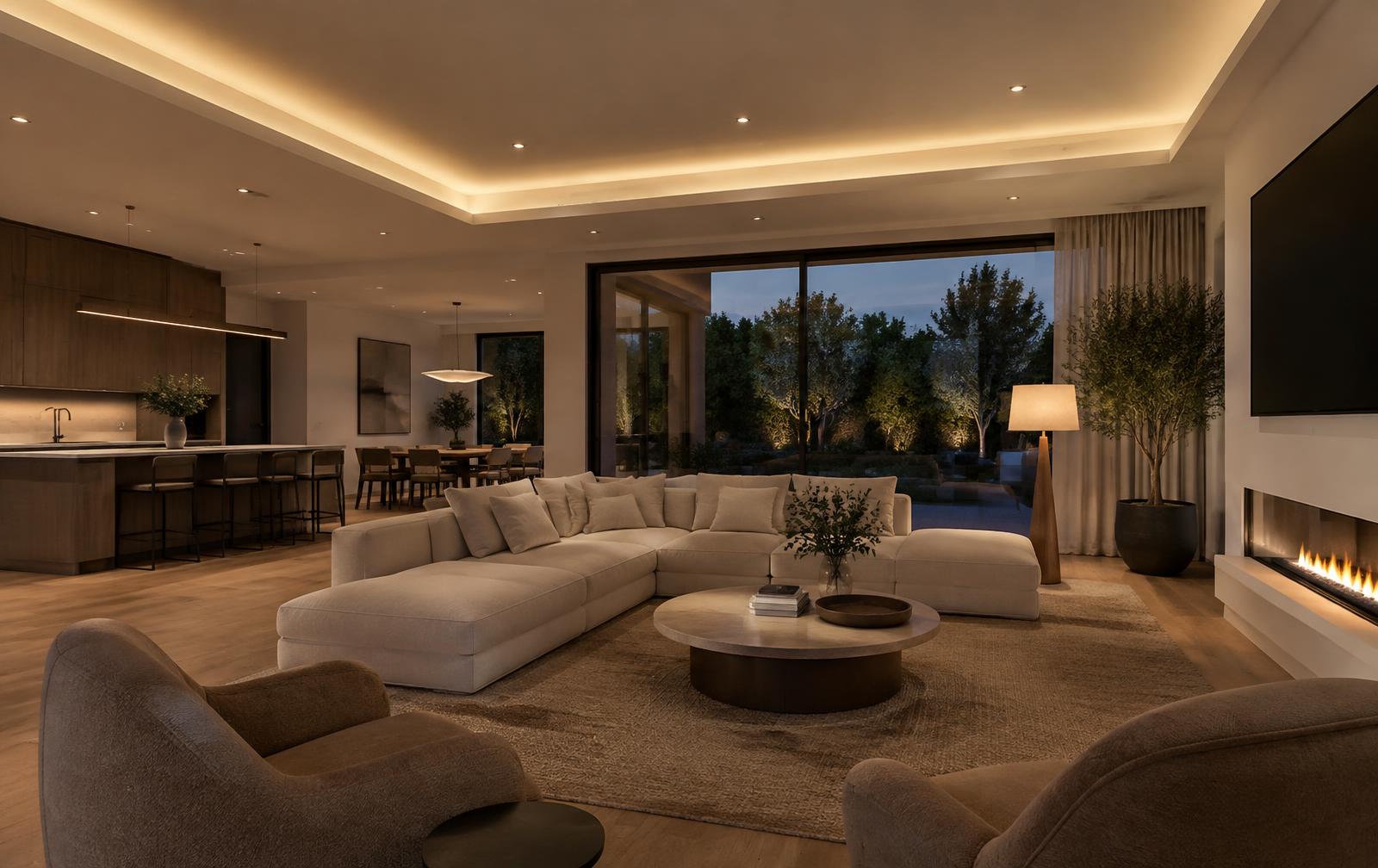 INTERIORS
An evening interior succeeds or fails on hierarchy. A lighting designer never asks one fixture type to do everything, yet a surprising number of renders ask exactly that, dropping in an even grid of downlights and wondering why the room feels like a clinic.
Think in three layers. Ambient light fills the volume and keeps shadows readable. Task light does a job in a specific place. Accent light directs attention and creates the contrast that makes a photograph interesting. Every fixture in the scene should belong clearly to one of those roles, and if you cannot say which role a fixture serves, it is probably the one making the image muddy.
Cove lighting is the ambient layer of choice in contemporary residential work because it lights the ceiling rather than the occupant. A concealed linear source set back from the ceiling edge produces a soft gradient that makes plaster look like plaster. The single detail people miss is the throw distance. If the strip sits too close to the ceiling you get a hot scallop right above the cove instead of an even wash. Between 100 and 150 millimeters of setback with a diffuse strip source usually behaves correctly.
Colour temperature deserves specificity. Warm residential practicals sit around 3599K, which reads as inviting without tipping into candlelight orange. Keeping cove and lamp sources on that value while leaving any exterior or view element cooler creates the temperature contrast that makes an evening shot feel like evening rather than an ungraded interior.
Downlights are where restraint matters most. In reality, a designer places them to wash a wall, light a worktop, or mark circulation, not on a uniform 900 millimeter grid. Pull fixtures toward the surfaces they are meant to light, use a narrower beam angle than feels natural, and accept that some parts of the room will be dim. Dim areas are what allow bright areas to register.
Practical lamps do the emotional work. A table lamp at eye level gives a room a focal point and a sense of occupation, and a shade produces two lighting effects at once, a downward pool and an upward glow, with the shade material itself glowing softly in between. Model the shade with correct thickness and translucency and it will carry the whole corner of the frame.
The mistake I see in almost every failed evening interior is over lighting. Real rooms at night are darker than people remember. Photographers expose for the bright zones and let the rest fall away. Build that intent into the render rather than lifting everything in post. A good test is to convert the image to greyscale and squint. If it is one broad tone, the lighting has no structure yet.
Fixture brightness should come from lumen output rather than arbitrary multipliers. A domestic table lamp is somewhere around 400 to 800 lumens. A recessed downlight tends to sit between 600 and 1200. Working in real units means a change to one fixture does not require rebalancing the entire scene, and it makes conversations with lighting consultants far less painful.
Windows in an evening interior need attention too. A dead black window reads as a hole in the wall. Even in deep night there is sky luminance, street lighting, and neighbouring windows. A low intensity dome or a simple backdrop at a fraction of interior brightness gives the glazing something to be, and the faint reflection of the room in the glass adds depth for free.
Bounce is the quiet ingredient. Pale ceilings and walls redistribute light in ways that flatten harsh sources, and a scene built with correct albedo values will do this on its own. Interior walls rarely exceed 0.8 reflectance in reality, and pure white surfaces at 0.9 or above will over brighten the space and produce that plastic, washed quality common in quick interior renders.
Finish by checking the image at thumbnail size. If the hierarchy survives at 200 pixels wide, the lighting is doing its job. If everything merges into an even glow, go back and turn something off rather than adding another fixture.