Workflow · 3ds Max, Blender, Forest Pack, Chaos Scatter
Realistic vegetation for arch viz: scatter, variation, and knowing when to stop
Scatter tools solved the geometry problem years ago. Believable planting is still hard because it is a design problem, not a plugin problem.
 WORKFLOW
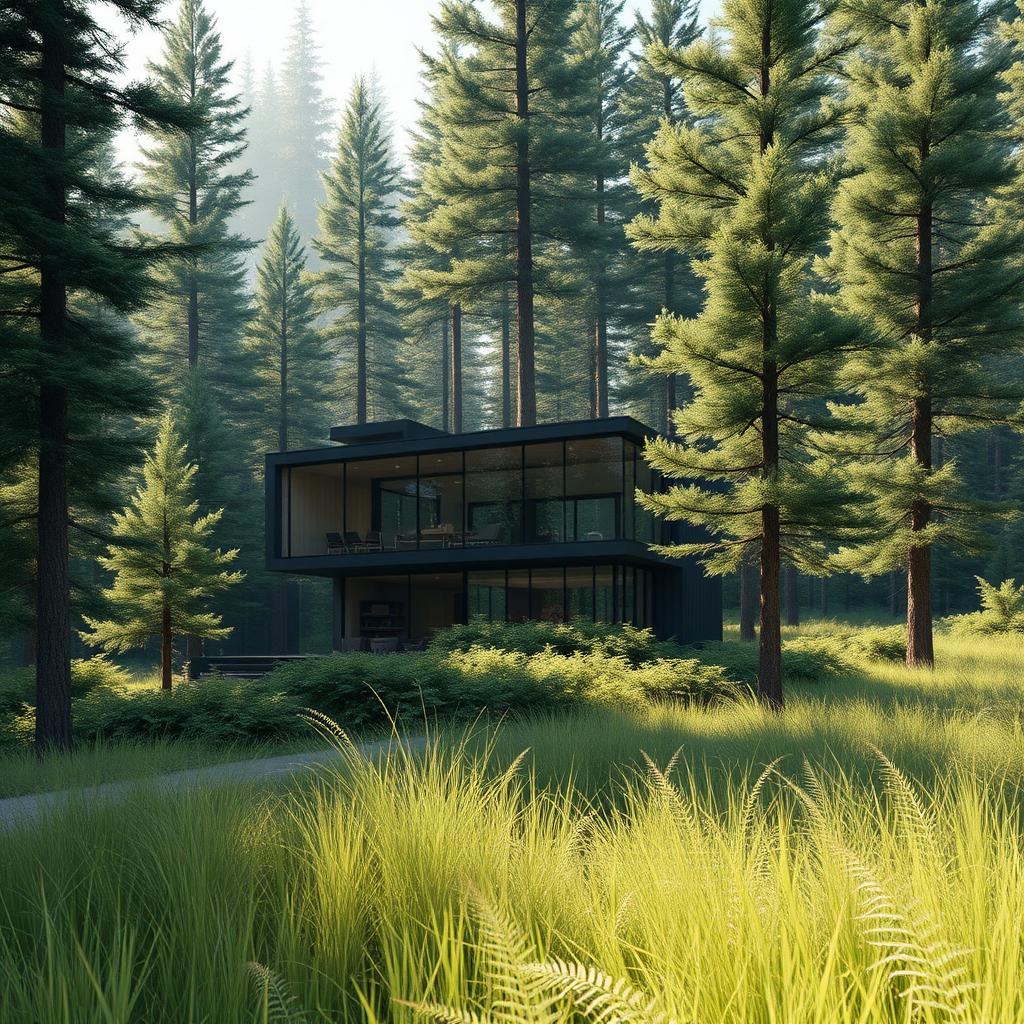
The forest around this house has about forty two thousand trees in it, and it took two hours to set up. The scatter is not the interesting part. What made this frame work is the twenty minutes I spent removing trees from certain areas, not adding them. That negative planting decision is what most tutorials skip and what separates a scatter render from a landscape.
Start with the ground plane. Not with the trees. The ground is where planting believability actually lives. Sculpt a bit of undulation, paint a weight map for drainage, and put a subtle noise on the height. A perfectly flat scatter surface reads as fake even if every tree on top is a hero asset, because real ground is never flat. The forest floor in this frame has thirty centimetres of variation across it, and none of that is visible in the final render. It is doing its work through the way roots and undergrowth sit slightly higher on the mounds.
For the trees themselves, three species minimum. Two species reads as a bad orchard. Four is realistic. On this scene I used Scots Pine as the dominant, Norway Spruce as the secondary, and a scattering of Silver Birch for the vertical breaks. All from the Megascans library at LOD 2, which is more than enough resolution for anything beyond about eight metres from the camera. Hero trees near the frame get LOD 0 or the full high poly.
Density varies non uniformly. This is the trick most artists get wrong. If you set Forest Pack or Chaos Scatter to 100 percent density across a paint area, you get a computed forest. Real forests are patchy. Some spots have three trees per ten square metres, others have none for a hundred square metres because a stream ran through there in the last fifty years. Paint density maps with actual patches of nothing, and the forest will read as one that grew rather than one that was planted.
Age variation matters too. In real forests, trees range in age from seedlings to elders within the same patch. Vary the scale by 40 to 60 percent, not the 10 to 20 percent that scatter tools default to. Rotate randomly in Y, but do not rotate in X or Z. Trees grow vertical. Tilted trees look like a wind storm just passed through, which is a valid choice but only if you commit to the whole scene reading that way.
Undergrowth is where scenes go from good to convincing. Ferns, grasses, low shrubs, and moss patches in the shaded areas. The undergrowth in this frame is three species of fern scattered along the path edge and clustered around the base of the pines, plus a grass card scattered at 8000 per hectare with weight based density falling toward the walking path. A path with no walking wear at the edge reads as unused, so I painted the path density to zero at the centre and 60 percent at the sides.
The single most powerful move for landscape believability is the reveal. Scatter something that partially hides the building. A pine trunk in the foreground that overlaps the corner of the house, a fern touching the frame edge, a shadow cast from an offscreen tree. Landscape architects understand this instinctively. The building is not an object in a field, it is something you glimpse through the site.
For performance, if your scatter is slowing the viewport to a crawl, cull by camera frustum first, then by distance. Chaos Scatter has this in the Distribution panel. Forest Pack has it under Areas. Both approaches let you scatter aggressively while only paying render cost for what the camera sees. On this scene the visible tree count is about eight thousand of the forty two thousand total. The rest exist because they cast shadows or reflect into the glass, but they never render as primary geometry.