Interiors · Corona 12
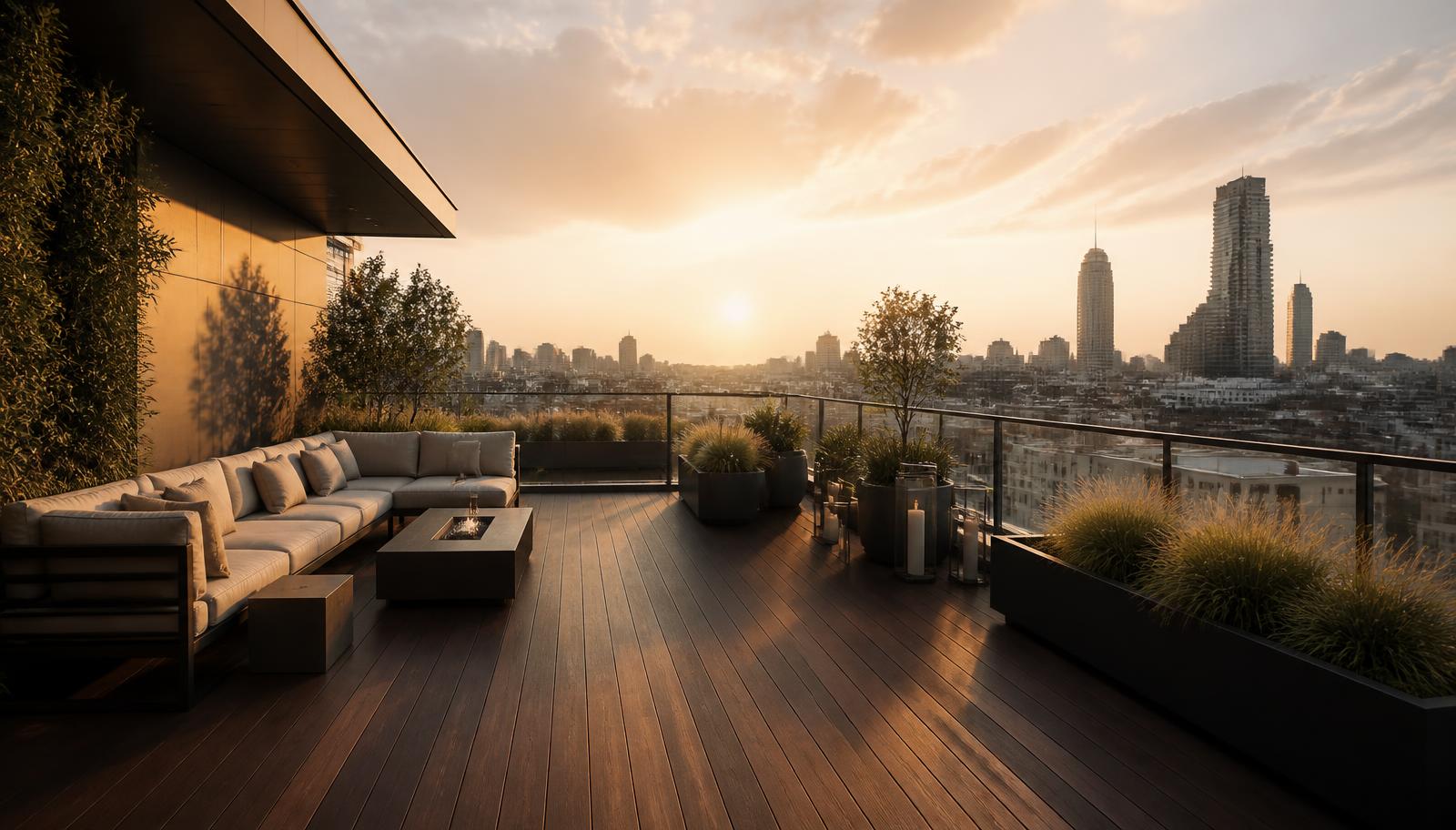
Rooftop terrace rendering: glass railings, planters, and city backdrop
Terraces are trickier than they look. The glass, the plants, the horizon line, and the sky all compete for attention. Here is how we keep them in check.
 INTERIORS
A rooftop terrace render is one of those images that looks effortless until you try it. The brief is usually simple: show this space as a place someone would actually sit. But the reality is that you are juggling a glass horizon, a sky that wants to dominate, plants that refuse to look natural, and outdoor furniture that has to feel weathered but not abandoned.
The first thing we lock is the glass railing. Frameless glass is basically a reflective sheet, and if it reflects the wrong part of the sky it becomes a bright rectangle that draws the eye away from the terrace. We model it as a solid pane with CoronaPhysicalMtl, set roughness to 0.02, and give it a very slight green tint in transmission. The trick is the angle. If the camera looks straight through the glass, you want it almost invisible. If it catches a low sun, you want a soft highlight, not a blown-out flare. We rotate the panels a few degrees toward the camera so the reflection reads as architectural rather than mirror-like.
Next comes the deck. Ipe or dark stained timber looks great in mood boards but can go dead in a render if the wood grain is too large or the roughness too uniform. We use a scanned plank texture with variation across the boards, set roughness to 0.55, and add a subtle displacement so the planks catch the sun. The deck should feel walked on, not freshly installed from a showroom. A few leaves and some pollen dust go a long way.
Planting is where most terrace renders fall apart. Randomly scattering pots does not read as landscape design. We work with a landscape architect whenever possible, and if not, we follow the same rule they do: a thriller, a filler, and a spiller. One tall grass or small tree for vertical interest, a mid-height shrub to fill volume, and a trailing plant to soften the edges of the planter. Three species per terrace is usually enough. More than five and it starts looking like a nursery catalog.
The city backdrop is almost always a plate or a low-poly skyline. We never model the whole city, but we do model enough to get accurate reflections in the glass and the wet surfaces. A few hundred meters of buildings, a simple dome, and a well-chosen HDRI cover most cases. The important part is the horizon line. If the horizon cuts the frame at eye level, the space feels exposed. If it sits lower, the terrace feels like a stage above the city. We usually keep the camera at seated height, about 1.1 meters above the deck, so the viewer is invited into the furniture rather than hovering over it.
Lighting is sun and sky, but with a deliberate time of day. Golden hour sells the lifestyle, but a fully orange sky competes with the interior lighting. We prefer 6:45pm, when the sun is just below the line of direct sight but still throwing warm side light. The sky stays readable, the city lights are not on yet, and the furniture gets the kind of raking light that makes every cushion look expensive. Fill light comes from the sky and from the warm interior bleeding through the doors.
Furniture is not just there to fill space. We choose pieces that make the terrace feel scaled to human use. A low sectional, a couple of small side tables, and one large fire element or coffee table is enough. Outdoor furniture is usually smaller than people expect, so we check real dimensions. A sofa that looks right in a showroom will look miniature on a sixty square meter terrace if you do not trust the model. Scale is the detail clients notice before they notice the lighting.
Entourage is minimal but deliberate. A glass with condensation, an open book, a pair of sunglasses, one throw blanket draped casually over an arm. We avoid too many props because a rooftop terrace should feel like a private escape, not a styled photoshoot. The best terrace renders suggest that someone just stepped inside and will be back in a minute.
In post, the deck gets a slight warm lift and the sky gets pulled back a few percent so the glass reads. We add a very light atmospheric haze to the far buildings to help depth. The final image is usually 80 percent render and 20 percent post. If you find yourself doing more, it usually means the camera or the materials were not quite right in the scene.
The hardest lesson is that a rooftop terrace is not an exterior render. It is an interior room with no ceiling. The same rules apply: keep the light believable, the materials honest, and the scale human. Once you stop treating it like a hero shot of a building and start treating it like a place to live, the image comes together.