Lighting · 3ds Max + Corona
Concrete chapel render: light, shadow, and the texture of silence
Sacred architecture is the hardest interior to render. One vertical slit of light, raw concrete surfaces, and the challenge of making emptiness feel intentional rather than unfinished.
 LIGHTING
There is a particular kind of quiet that good chapel renders have. It is not just about empty space. It is about the way light falls on a wall, the way a bench sits in a beam, and the way the whole room asks you to slow down. Most religious interiors I see rendered fail because the artist treats them like a hotel lobby. They overfill, overlight, and overexplain. A chapel needs restraint, and restraint is harder than decoration.
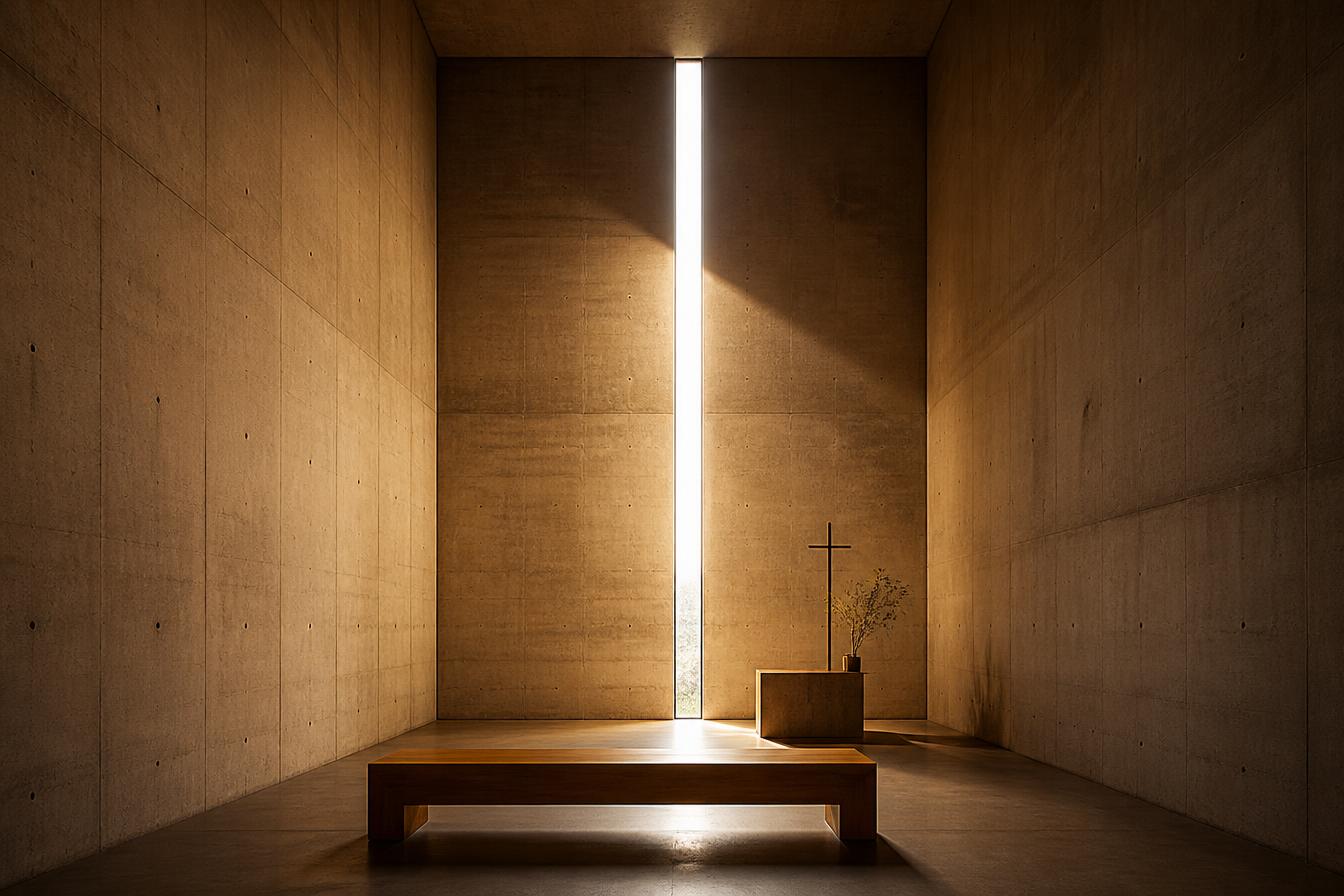
The architecture here is simple: a rectangular box of board formed concrete, a single wooden bench, a small altar block, and a vertical skylight cut into the end wall. No windows to the sides, no decorative ceiling, no art. The brief, if you can call it that, was to make silence visible. The solution is almost entirely in the light.
We started with the skylight. In Corona, a vertical opening behaves differently than a horizontal one. The sun only enters when it is directly in line with the slit, so the timing of the day matters enormously. For this render we set the sun at 11:30am with a CoronaSky turbidity of 3.2. That gives a warm but slightly soft beam rather than a hard laser. The color temperature of the direct light is 3599K, which reads as warm sunlight on concrete without sliding into orange.
The concrete is the second character. We used a scanned board formed concrete with displacement at 4 millimeters and a roughness map that varies between 0.55 and 0.85. The trick is to let the formwork texture catch the raking light. Without displacement, the shadows from the skylight would read as flat projections. With displacement, each board edge creates a tiny shadow line, and the whole wall becomes a surface that you can almost feel.
We made one deliberate mistake early on. The first version had a second, wider skylight higher up, thinking it would lift the ambient level. It killed the image. The second light source flattened the beam and removed the drama. We deleted it and accepted that the room would be dark except for the single column of light. That darkness is the point. The surrounding concrete is not underlit; it is the negative space that lets the beam exist.
Materials are limited and specific. The bench is pale oak, rough sawn, with a satin lacquer. The altar is a single block of the same wood but with a burned finish. The floor is polished concrete with a very fine aggregate, reflecting the beam at 20 percent opacity. We avoided rugs, cushions, plants, or anything that would soften the severity. In a chapel, every object is a decision. The emptiness is not absence; it is the design.
Camera placement was unusually low, at seated eye height. A standing camera makes the room feel like a gallery. A seated camera makes it feel like a place to be in. We used a 35mm equivalent lens to keep verticals straight and the perspective natural. The composition places the bench slightly off center, aligned with the light beam, so the viewer is invited to sit rather than to observe.
In post we did almost nothing. We pulled the shadows down 5 percent, added a slight warm push to the light beam, and left the concrete alone. The biggest temptation was to add dust particles in the air to make the light beam visible, but we resisted. Visible dust would turn the scene into a cathedral. The goal was a quiet chapel, not a stage set.
The lesson, if there is one, is that sacred architecture is about subtraction. Every time you want to add a fill light, a plant, a material variation, ask whether the image needs it. Most of the time it does not. The best chapel renders are the ones that stop just before they become interesting. This one stopped early enough that the silence is still there.