Lighting · V-Ray
Fireflies in glass and mirror interiors: find the light, not the denoiser
A stray white pixel in a reflection is not a sampling problem to be drowned in settings. It is a light that is too small and too bright, seen through a path almost nothing else sampled. Why reflective interiors breed fireflies, and the order in which to fix them.
 LIGHTING
A firefly is one pixel that received an absurd amount of light. A single ray found a small, very bright source through a path that no other sample in that area happened to find, and the result is a white dot on a dark surface, usually inside a reflection. It is not dust, it is not a texture error, and it is almost never fixed by raising overall samples, which is why so many artists spend an afternoon fighting the same four pixels.
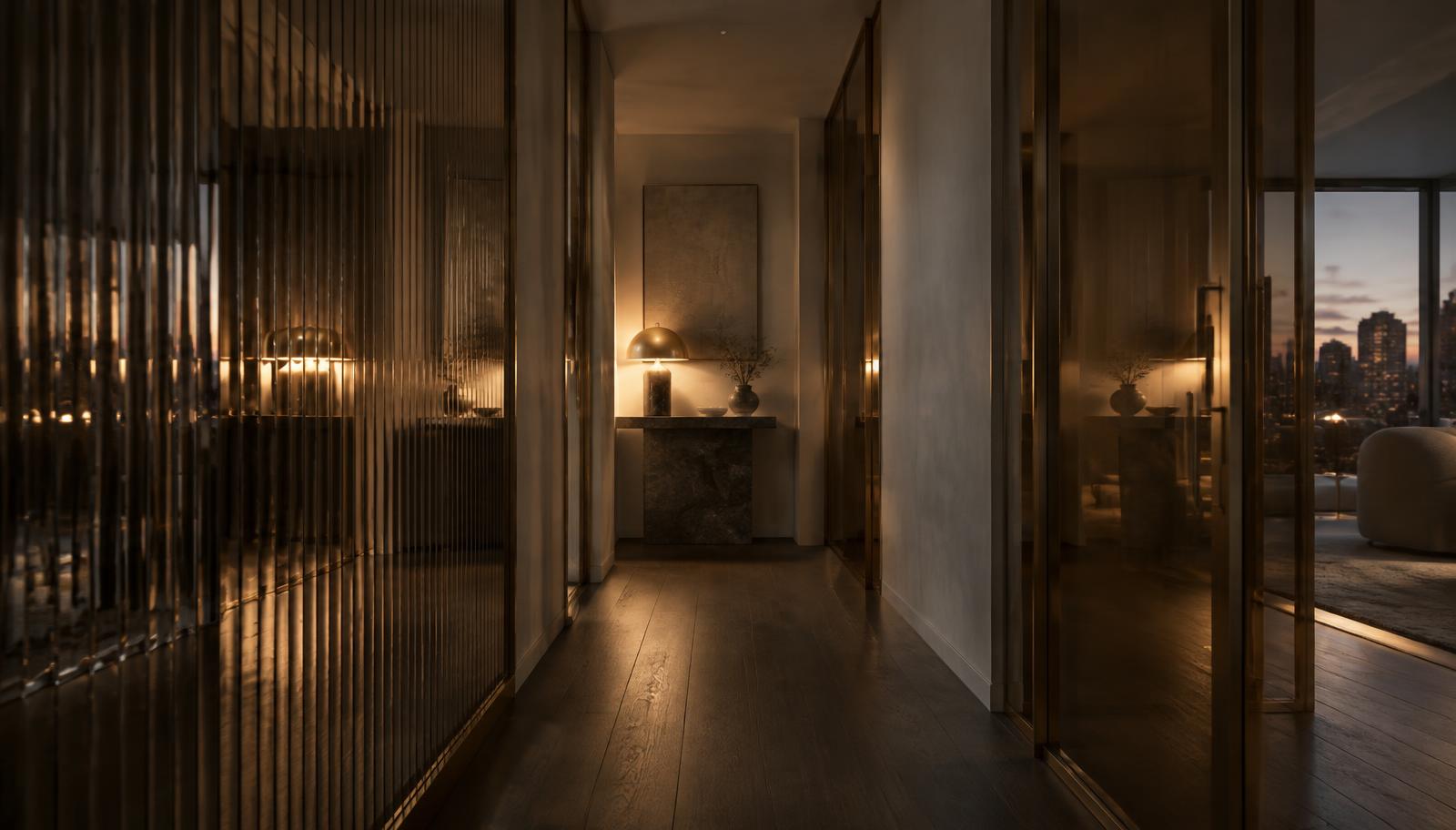
Glass and mirror interiors are the natural habitat of fireflies because those surfaces multiply paths. A diffuse wall gives the renderer one obvious way to be lit. A mirror wall adds a second scene, a fluted glass panel adds a refracted and blurred version of that second scene, and a brass frame adds a third, glossier one. Each bounce is another chance for a ray to stumble onto a bright emitter that the surrounding samples missed, and the variance climbs with every reflective layer in the shot.
So diagnose before you adjust anything. Fireflies are a light problem, and the fastest way to find the offender is to isolate lights: mute them one group at a time, or render with light mixing, and watch which switch makes the dots vanish. If you skip this step you will spend the evening tuning sampling thresholds that were never the cause.
The usual suspects are consistent. Thin emissive geometry standing in for an LED strip, a spotlight with a tiny emitter, a downlight represented as a small bright disc, the sun leaking through a gap that should be closed, and any bright source sitting behind glass, since refraction concentrates rays into a narrow set of paths. Caustics enabled on a glass object in a wide shot is another classic, and a bright window or a sun patch visible in a mirror is the one people least expect.
The governing rule is to reduce radiance, not brightness. A physically small emitter set to a high intensity is a variance machine: few rays find it, and those that do carry enormous energy. Widen the emitter to the real size of the fixture and lower its intensity so the illumination stays the same. A large panel at low radiance is cheap to sample and produces almost no fireflies, which is why real lighting designers use diffusers and why archviz lighting looks better when the emitters match the hardware.
Glass itself deserves a check. Window panes should use thin refraction rather than a solid volume with two interfaces, and you should not be stacking unnecessary refraction where a single pane does the job. Every extra refraction increases path complexity and the odds of a rare, high energy hit. Keep the index of refraction physically sensible, around 1.52 for ordinary glass, and do not enable dispersion in a shot where nobody will ever see the spectrum.
Mirrors and reflective walls need a specific trick. If the reflected image contains a bright source that is not itself in frame, that source is contributing noise through a path the camera only reaches via the mirror. You can hide it from reflection and refraction rays while keeping it visible to camera, or replace it with a dimmer, larger proxy in reflection. This is not cheating, it is the same logic as making an emitter bigger, applied to a path you cannot otherwise control.
Caustics should stay off unless the shot is genuinely about a caustic pattern. A pool, a glass vessel or a bottle on a table with caustics enabled in an otherwise ordinary interior is a firefly farm, and the visual gain in a wide shot is negligible. Where a caustic really matters, isolate it: render that element separately, or use a photon based approach on a tight crop rather than across the whole scene.
Culling thresholds are the next lever, and they are worth understanding rather than cranking. A light contribution threshold tells the renderer to ignore contributions so small that they never matter, which removes exactly the rare, tiny paths that become fireflies. Set a maximum reflection and refraction depth that matches what the shot actually needs, since an unbounded depth lets rays wander into emitters the camera will never consciously see.
Only after those fixes should you touch sampling, and even then think in terms of lights rather than global numbers. Light portals around a window help the renderer find the important paths, and raising a light's subdivisions on the one small fixture that is misbehaving is far more efficient than doubling a global setting. The difference is visible in the render clock, not just the noise.
Denoising is the last step, not the first. A denoiser asked to clean a scene full of fireflies does not remove them, it smears them into a haze and eats the detail around them, which is why a heavily denoised glass interior often looks soft and plasticky. Fix the light, then denoise lightly. The correct habit is a small crop render at full quality with the denoiser switched off, inspected at one hundred percent, before the full frame ever starts.
A single stray pixel is a two minute job in post with a spot heal, and there is no virtue in leaving it. But a scene that produces hundreds of them is telling you something material or something luminous is wrong, and the fix belongs upstream. Chasing the dots one at a time in Photoshop while the emitter stays tiny is how a studio ends up re grading the same image every week.
Run a short checklist before a night interior with glass goes to render. Are the emitters at least as large as the real fixtures? Is any sun getting through a gap it should not? Are window panes set to thin refraction? Is the reflection and refraction depth limited to what the shot needs? Are caustics off? Does any mirror see a source that the camera never sees? Then a crop, no denoiser, one hundred percent. Six questions, and the frame arrives clean.
Fireflies are not a mystery and they are not a rite of passage. They are a measurement of how concentrated your brightest light is, and reflective interiors simply make that measurement visible. Spread the light out, keep the paths honest, and the pixels stop misbehaving.