Workflow · Any renderer
Lens choice in architectural visualization: why 35mm is quietly winning
The 24mm wide angle that dominates real estate CGI is not the lens most architectural photographers actually use. A working artist argument for tighter framing.
 WORKFLOW
Somewhere along the way, arch viz decided that the correct lens for a building was 24mm. Real estate demanded it because agents wanted the whole kitchen in one shot. That decision then leaked into competition boards, portfolio hero images, and Instagram, and now a generation of artists opens every new camera at 24mm without thinking about it. The buildings that come out the other side look like real estate listings. They are not wrong, exactly. They are just not what an architectural photographer would have done.
Iwan Baan does not shoot buildings at 24mm. Neither does Julien Lanoo or Rasmus Norlander. The working focal length across published architectural photography is 35mm to 50mm equivalent, with wider lenses reserved for interiors that genuinely cannot be captured otherwise or for a specific compositional intent. The reason is straightforward. Wider lenses distort proportion. A 24mm shot of a townhouse makes the ground floor feel enormous and the roof feel small, which reads as a real estate listing precisely because it flatters volume the way listings need to flatter volume.
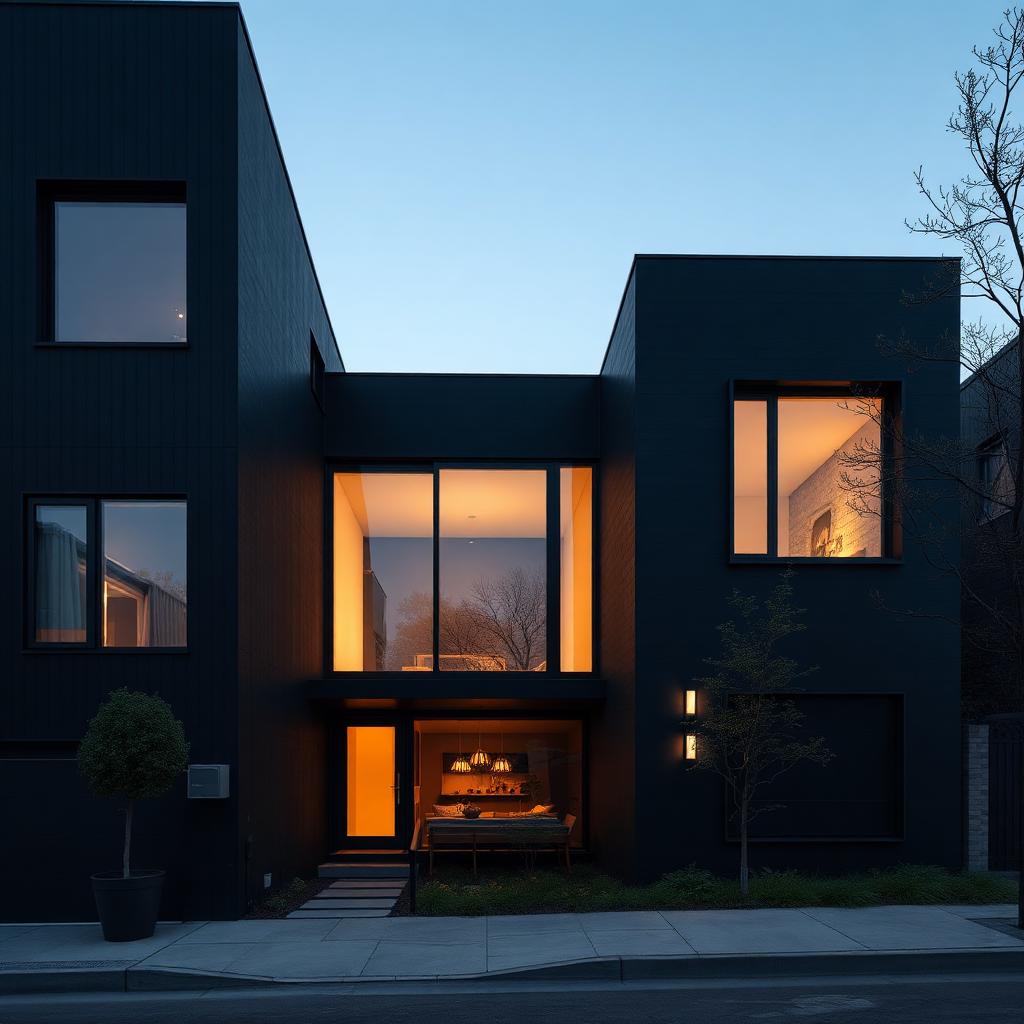
The frame for this article was shot at 35mm equivalent, tripod at 1.6m, two point perspective forced so the verticals stay vertical. The result is a building that reads as its actual proportion. The window looks like a window, not a portal. The doorway looks approachable rather than diminutive. And the composition has room to breathe on either side of the facade, because at 35mm you can actually step back on the pavement and let the streetscape frame the building.
There is a productivity argument here as well. A 35mm lens means less warping to correct in post. The famous keystoning where verticals lean inward at the top of a 24mm shot is either shift lens work in real photography or a lens correction node in post for CG. Every one of those corrections crops the image. Shoot wider and you crop more, which means you either render at higher resolution to compensate or accept a smaller usable area. Shoot at 35mm and there is essentially nothing to correct.
Interior lens choice is more nuanced. A living room needs to be readable, and sometimes 24mm is the honest answer if the room is small enough that a 35mm frame would just show a wall. But even here, my default has moved to 28mm rather than 24mm, and I look for compositions that use depth rather than width to communicate the space. A dining table in the foreground with the kitchen visible beyond reads more like a home than a full width elevation shot of the whole open plan.
There is a specific composition trick worth knowing. On any exterior at 35mm, tilt the camera 1 to 2 degrees down from perfectly level. Do not correct it in post. The subtle downward tilt lets the roof line breathe against the sky and prevents the perfect grid look that reads as CG. Look at any photograph you admire and you will notice this near invisible tilt. It is what makes the image feel like it was taken by a person rather than levelled by a computer.
Finally, a note on longer lenses. There is nothing wrong with a 50mm or 85mm elevation on the right project. A detailed corner condition, a shop front, a specific material transition all read better at longer focal lengths because they concentrate attention. Not every arch viz shot needs to include the whole building. Some of the strongest images in the field are detail shots that would fit inside a real estate hero frame with room to spare.