Interiors · 3ds Max + V-Ray
Penthouse interior at twilight: when the city becomes your fifth wall
High rise apartments are not just rooms with good views. They are rooms where the skyline is a material. Here is how to render a twilight penthouse without losing the interior to the glass.
 INTERIORS
A penthouse is not a room with a window. It is a room that is half architecture and half city. The mistake most people make is rendering the interior first and then treating the skyline as a backdrop. The skyline is not a backdrop. It is a wall, a light source, and a reflection, all at once. If you get that relationship wrong, the room feels like a stage set hovering above a postcard.
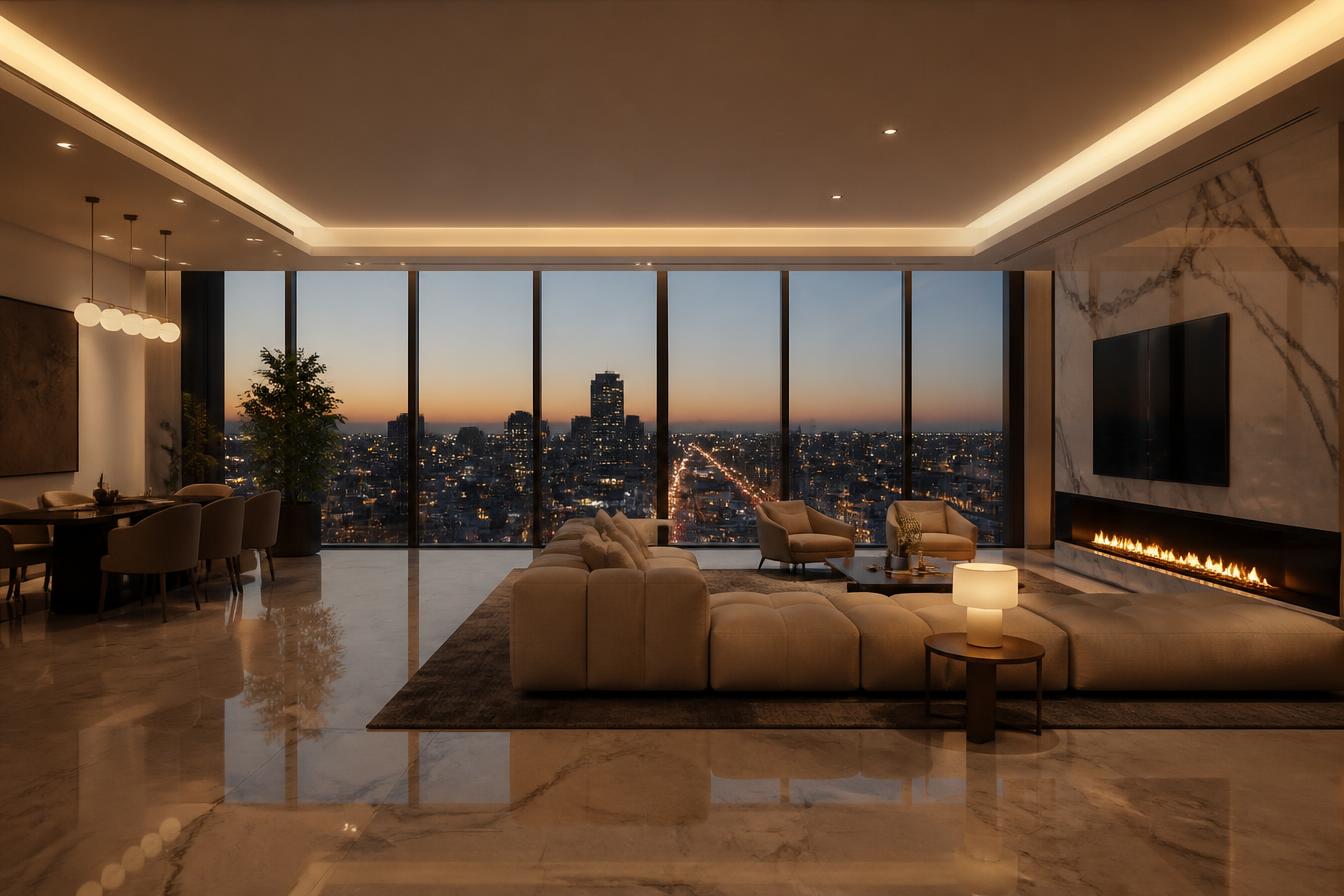
This scene is a high floor living room on the 45th level of a tower, looking west over a city at twilight. Floor to ceiling glazing on three sides, a low sofa, a marble fireplace, and indirect ceiling coves. The challenge is to keep the interior warm and readable while the city outside is still bright enough to be a feature. It is a balance problem, not a lighting problem.
We set the exterior sky as a V-Ray HDRI at 5500K, slightly cool, twilight exposure. The city itself is a backplate rather than a fully modeled skyline, which is standard for residential interiors unless you are doing hero shots of the tower. The backplate is a 16K HDR image with enough detail to reflect believably in the glass but not so much that it competes with the furniture. Reflection glossiness on the windows is set to 0.98 so the city reads softly rather than mirror sharp.
Interior lighting is all 3599K. The ceiling coves, table lamps, and the linear fireplace all share the same color temperature. That consistency is what makes the room feel designed. If the cove is 3000K and the lamp is 4000K, the space falls apart. We keep the coves at 80 percent of the lamp intensity so they act as ambient fill without becoming the hero. The fireplace is the brightest point, both because it is a real flame and because it gives the composition a warm anchor on the right side of the frame.
The camera is a V-Ray physical camera at ISO 400, f/5.6, shutter 1/60s. We expose for the interior, not for the city. That means the backplate gets slightly darker than it would in a real photograph, but it keeps the furniture from disappearing into silhouette. The compromise is that we use a subtle gradient in post to lift the lower third of the city backplate so it does not feel like a hole behind the sofa.
Materials in a penthouse are about luxury without shouting. The floor is polished Calacatta marble with a clear coat at 0.92 glossiness. The sofa is a low pile boucle in warm oatmeal. The rug is a hand knotted wool with enough displacement to catch the cove light. The walls are a matte plaster at 0.68 diffuse. Everything is chosen to reflect or absorb the 3599K light in a flattering way. Chrome is used sparingly; too much metal and the room becomes a disco ball.
One detail that matters more than you expect: the mullions. The window frames are slim black steel, 40 millimeters, with a brushed finish. If the frames disappear, the glass feels like an infinite plane and the room loses its sense of enclosure. If the frames are too thick, they read as prison bars. We modeled the glazing as a real double pane unit with a slight green tint and edge darkening, which adds that subtle built feeling you get in actual high rise glass.
In post, we split the image into three zones: the sky, the city, and the interior. The sky gets a cool blue push, the city gets a slight contrast reduction to keep it atmospheric, and the interior gets a warm highlight lift on the furniture. The key is that the three zones talk to each other. A cool sky plus a warm interior creates depth. A warm sky plus a warm interior creates a flat orange mess.
The final image works because the city is not competing. It is present, glowing, alive, but it does not steal the sofa. The room feels expensive because it is calm enough to let the view exist. That is the real trick of penthouse rendering: you are not selling the glass. You are selling the life that happens on the inside of it.