Breakdown · V-Ray 7
Curtain wall reflections: how to get glass facades that look built, not pasted
Glass is not invisible. It is a mirror that happens to let light through. Here is the V-Ray workflow we use for office towers and cultural buildings with big facades.
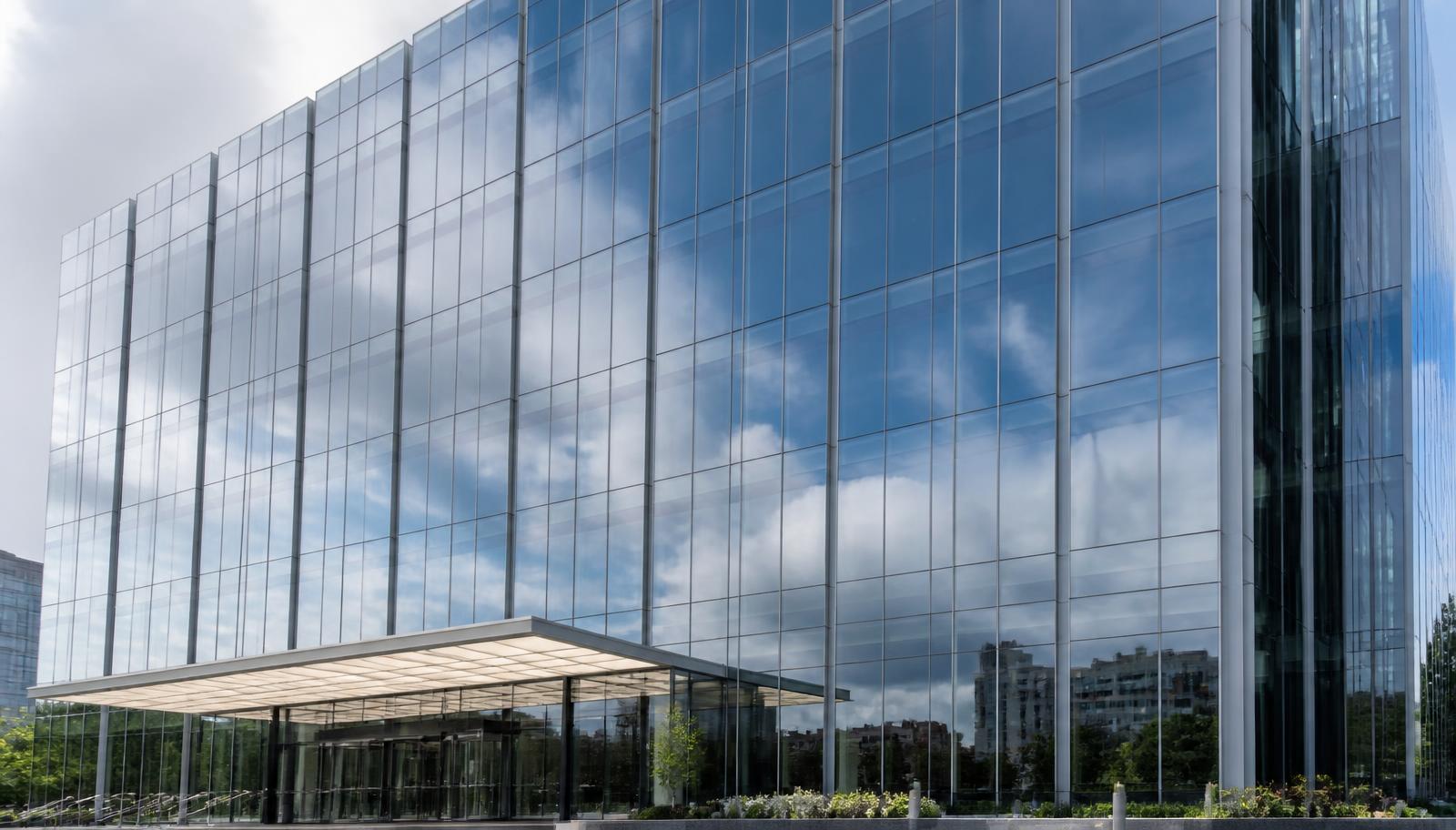 BREAKDOWN
Every junior artist I have trained eventually makes the same mistake with curtain wall. They set the glass to 100 percent transparent and wonder why the building looks like a hologram. Glass in real life is not invisible. It reflects, it distorts, it carries color, and it changes depending on the angle you see it. If you want a facade to look built, you have to render it like a mirror that light passes through, not a hole in the wall.
In V-Ray 7 we start with VRayMtl and set the IOR to 1.52 for architectural float glass. This is the number most spec sheets give, and it is the number that makes reflections behave correctly at shallow angles. We set the reflection color to a very light grey, not white, because perfect chrome reflections are for automotive showrooms. A subtle desaturation gives the glass the soft silver quality you see on real buildings.
The facing ratio is the part nobody teaches. Head-on glass is mostly transparent. At a steep angle, it becomes almost fully reflective. We map the reflection and refraction amounts to a falloff curve so the vertical glass shows the interior while the angled panels at the edges reflect the sky. Without this curve, the whole building reads as either a mirror box or a transparent shell. Neither is right.
For the reflected environment, we build a simple city block around the building. It does not need detail. It needs the right color, scale, and height. A row of six to eight generic mid-rise buildings with varied window patterns is enough to create plausible reflections. If the sky is bright, we also add a subtle ground plane so the lower panels reflect something warmer than grey. A good reflection tells the viewer there is a world around the building, even if that world is mostly implied.
Mullions are geometry, not just dark lines. We model them as 50 to 150 millimeter boxes depending on the system, with a small reveal where they meet the glass. This shadow line is what separates a real curtain wall from a sheet of glass with stickers. The material is usually a dark anodized aluminum, which we set as a glossy metal with a low roughness. If it is too reflective, the mullions disappear into the glass. If it is too matte, they look like black bars. We aim for a middle ground where they read as crisp edges without stealing attention.
The sky is the real star of most facade shots. A flat blue gradient is the fastest way to make a render look like a render. We use high-resolution sky plates, either photographed or generated with a solid sky model, that have real cloud structure and subtle color variation. The glass will reflect whatever is there, so if the sky is interesting, the building becomes interesting. If the sky is boring, no amount of material tweaking will save it.
One practical tip: render the facade from an oblique corner, not straight on. A straight-on elevation makes the glass reflect the camera, which is usually a white void, and the symmetry is unforgiving. A corner view shows the depth of the mullions, gives the glass something to reflect on both sides, and makes the building feel like a physical object in space. Clients always pick the corner view.
Interior lights behind the glass need to be visible but not legible. If you can read every desk lamp and chair silhouette through the facade, the glass is too transparent. We usually place a few warm panels behind the glass at varying intensities and let the glass transmission and reflections do the work. The goal is a suggestion of occupancy, not a floor plan.
Post-processing is light. We correct the verticals, add a slight contrast curve to the glass reflections, and sometimes warm the mullions to match the sky color. If the reflections are too busy, we use a soft blur on a reflection pass and blend it back at 30 percent. The final image should feel like a photograph taken by someone standing on the plaza, not a diagram of a facade system.
The biggest compliment we get on a curtain wall render is when a client asks if it is a photograph. That does not come from perfect geometry. It comes from the glass behaving like glass. Reflection, transparency, angle, and sky. Get those four right and the rest is just framing.