Lighting · 3ds Max, V-Ray
Night exterior renders: illuminated facades without the flare crutch
IES profiles, deep blue sky exposure, and the interior reveal that carries a night facade. A working guide for commercial night shots.
 LIGHTING
Night exterior renders reveal how the building actually works. A well designed office building at night reads as a section drawing with the lighting hierarchy visible from the street. A poorly designed one reads as a security lit box. The render is not just marketing, it is a lighting design review, and treating it as such raises the quality of both the design and the image.
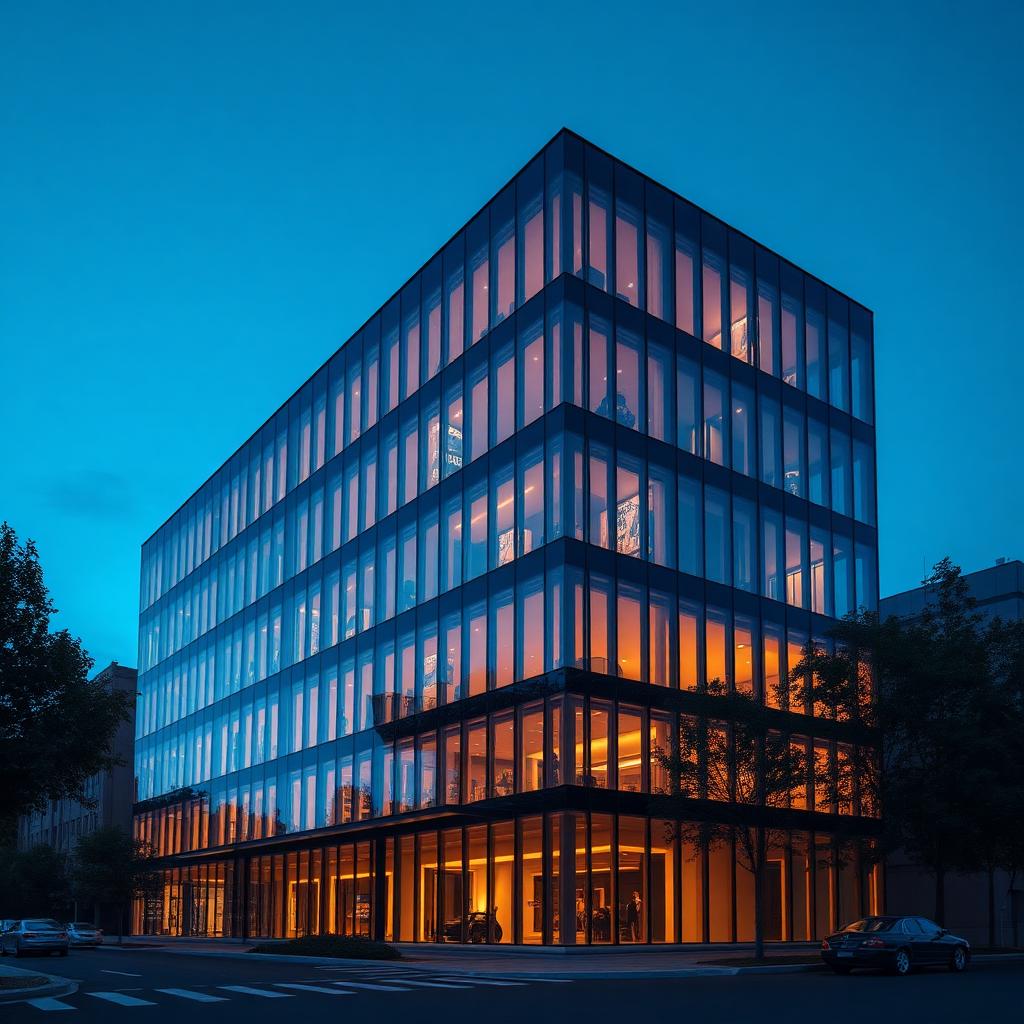
Sky exposure is the first setting. A night render should be dark. Not black. Dark. The right sky for a commercial exterior in a city context is a deep royal blue at EV 4.5 to 5.5, which corresponds roughly to civil twilight lingering thirty minutes after sunset. If you push the sky darker than that, the building floats on nothing. If you push it lighter, the interior lighting does not read as bright by comparison.
Interior lighting is where the building tells its story. Every floor should have identifiable activity. Some offices lit, some dark, some with a person visible at a desk, some with meeting rooms lit and workstations dark. This variability is what makes a night facade look occupied. A building where every floor is uniformly lit reads as a marketing mockup. A building where the top three floors are dark and the ground floor lobby is warmly lit reads as a Thursday evening.
For the interior lighting values, aim for realistic lux levels. General office lighting is 300 to 500 lux at desk height. Corridor lighting is around 200 lux. Lobby lighting is 250 to 400 lux depending on programme. Feed those values into your area lights or IES profiles and the exterior render will pick up realistic brightness in each floor without any manual balancing. The wrong values are what create the video game look where every window is uniformly overexposed white.
IES profiles matter enormously for exterior lighting. Any downlight, wall wash, or facade grazer should be an IES profile from the actual specified fitting, not a generic point light. Manufacturers make these available for free download. The light pattern from a real IES wall wash on brickwork is a specific scallop that reads instantly as architectural. A generic point light gives you a soft circle that reads as CG. This one shift raises the sophistication of night exteriors more than almost anything else.
Facade uplighting is powerful and easy to overdo. A subtle graze on the ground floor colonnade at 100 lux average intensity reads as intentional. Full facade floodlighting from below reads as an airport terminal at 3am. When in doubt, less. And place the lights so their beams die into the sky above the building. Facade lights that spill uncontrolled into the sky are a real world lighting pollution problem, and rendering them that way tells the planning committee you have not thought about it.
One trap on night renders is the lens flare. There is a strong temptation to add a lens flare or bloom on every visible light source. Resist. Real cameras have flares but they are subtle, and modern arch viz overuses them so heavily that a flared night render now reads as low budget. Add a very slight bloom at 5 percent influence in post, not the aggressive default that most compositor tools ship with.
For the reflected environment, if the building is near water, wet asphalt, or reflective glass on adjacent buildings, use those reflections deliberately. A puddle in the foreground reflecting the facade nearly doubles the height of the image and gives you a compositional anchor. A neighbouring glass facade catching the corner of your building creates a sense of urban context that a standalone building render never achieves.
The last note is on time of day precision. Every night render should have a clock time attached. Something like Weeknight, 9:15pm, October. That specificity is what separates a mood render from a marketing render. Committees respond well to it, clients feel that the render is a study rather than a sell, and the discipline of picking a time forces you to be honest about which floors would realistically be lit.