Lighting · Corona
Skylights and rooflights: rendering daylight when the sun comes from above
A rooflight changes the geometry of daylight completely, and most renders ignore that. The shaft, the reveal, the bright ceiling and the blue glass are what make a skylight space read as real. How to light and model top-lit interiors properly.
 LIGHTING
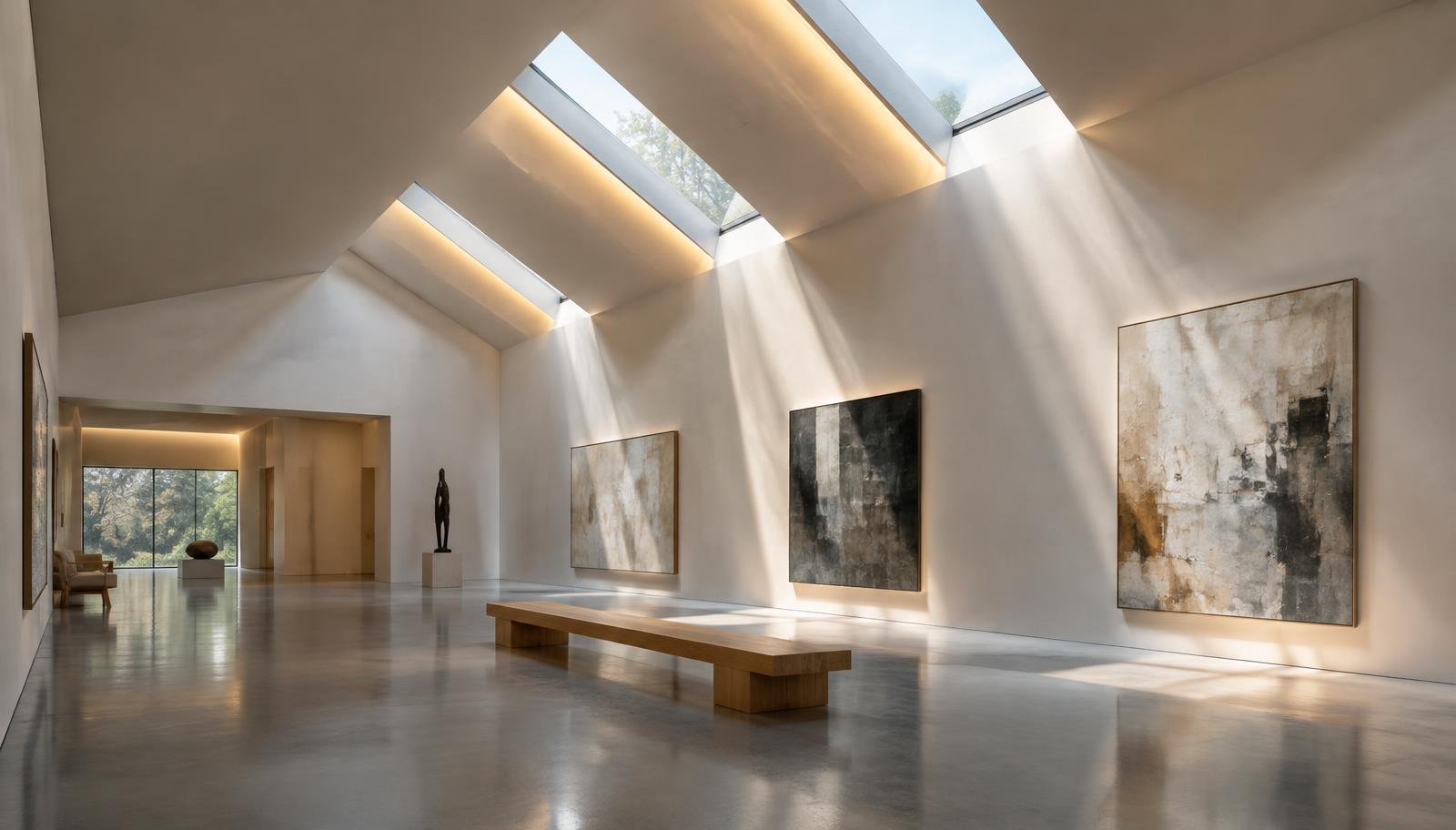
Top-lit spaces are among the most beautiful subjects in architectural visualization and among the most commonly mishandled. The reason is that a rooflight behaves nothing like a window. Daylight through a facade arrives low and wide, it washes the floor and the far wall, and the ceiling stays dark. Daylight through a roof arrives steep, it lights the ceiling and the upper walls first, and the floor receives mostly bounce. A renderer who treats a skylight as a window on the ceiling produces a room that looks lit from every direction at once and feels like nothing in particular.
Start with the reveal, because the reveal is the light fixture. A skylight in a thick roof with deep plastered sides is a directional softbox with a long throat, and the depth of that throat determines how far the light reaches and how sharp the shaft edge is. A shallow rooflight in a thin roof gives a wide, soft pool. A deep shaft in a 400 millimetre roof build-up gives a blade of light with a defined edge that moves with the sun. Model the actual reveal thickness rather than cutting a hole in a slab, and half the realism is already there.
Sun alignment is the second driver. Shafts only appear when the sun geometry lines up with the opening, so the date and time on the sun are not decoration, they are the shot. Pick a sun altitude that throws the shaft onto a wall rather than straight down a void, because a shaft landing on a vertical surface is readable while a shaft falling on a floor plane is a patch. In the northern hemisphere a south-facing rooflight at mid morning or mid afternoon is usually the sweet spot; run the sun position for the actual orientation the architect drew, not a generic afternoon.
Then respect what the ceiling is doing. In a well handled rooflight render the ceiling is the brightest large plane in the frame, lit by the sky through the opening, and the floor is a step darker. Renderers who add fill lights to lift the floor usually destroy exactly this relationship. Let the bounce do it: a light concrete or plaster floor returns enough energy to keep the lower half of the frame readable while the ceiling still dominates. If the floor needs more light, the honest fix is a lighter floor material or a larger opening, not a fill card.
The glass itself deserves attention. A real double glazed rooflight loses a meaningful share of the light and shifts it, because low-E coatings and laminated panes carry a slight green or blue green cast. A perfectly transparent hole in the roof reads as fake for the same reason a perfectly clear window does. Give the glazing a subtle transmission tint and a small transmission loss, and add the frame: glazing bars, a shadowing reveal, and the slight occlusion of the opening. On a sunny day the mullion shadows crossing the shaft are one of the most convincing details in the frame.
Mixed colour temperature is a fact of top-lit buildings and a good thing to render honestly. Daylight through the roof is cool and it moves, while most specs add electric light in or near the reveals, often at a warm 3000K, and in images the warm accent in the reveal against the cool shaft is what gives the space depth. Keep the two sources distinguishable. When the whole frame converges to a single neutral colour temperature, the skylight stops reading as a light source and becomes just a bright patch.
Beware the two shadow world problem. A space with both facade windows and rooflights receives light from very different directions, and objects cast two sets of shadows of different softness and different angles. Real buildings do this and eyes accept it, but it only reads when each shadow set is physically consistent with its source. The mistake to avoid is softening one set in post to taste, which makes the frame feel like a composite. Choose a dominant source, keep its shadows hard and directional, and let the secondary source contribute softer fill.
Noise is the practical tax of small bright sources. A rooflight is a small emitter relative to the room, which means more variance per sample than a sky dome. Expect longer times or higher sample settings than an equivalent facade-lit scene, and check the shaft edges for fireflies before the final frame. A small increase in light sample subdivisions on the sun and the sky, or a modest clamp on secondary bounces, is usually enough. Denoise last and lightly, because a denoiser will happily eat the shaft edges that took the effort to place.
Composition decides whether the shaft is the hero or a supporting detail. Shot at standing eye height with a wide lens, a rooflight reads as a bright ceiling feature and the room reads as a whole. Drop the camera slightly or angle up a little and the shaft becomes a graphic element crossing the frame, which is often the stronger image. Both are valid, but they are different briefs: the first sells the room, the second sells the light. Decide before rendering, because the exposure strategy differs too.
Scale the effort to the shot. For a secondary image in a set, an accurate sun, a modelled reveal and a tinted glazing is most of the work. For a hero image, add dust and atmosphere in the shaft, because a faint volumetric is what makes a visible light shaft possible at all; without it the shaft exists only where it lands. Keep the density low. A heavy volumetric fog in a domestic or gallery space is the fastest way to make a serious project look like a concept art mood piece.
Before sending a top-lit render, run the checks that matter. Is the ceiling the brightest plane, and does the floor sit below it? Does the shaft edge have the softness that the reveal depth implies? Do the mullion shadows fall where the sun says they should? Is the glazing tinted, and is there a frame? Is the warm electric accent distinguishable from the cool daylight? Five answers, and the skylight space reads as built rather than rendered.