Lighting · Corona
Sun angle and shadow quality: the two settings that decide an exterior render
Shadow softness, sun altitude, and contact behaviour tell the viewer more about your competence than any material in the scene. What to set and why.
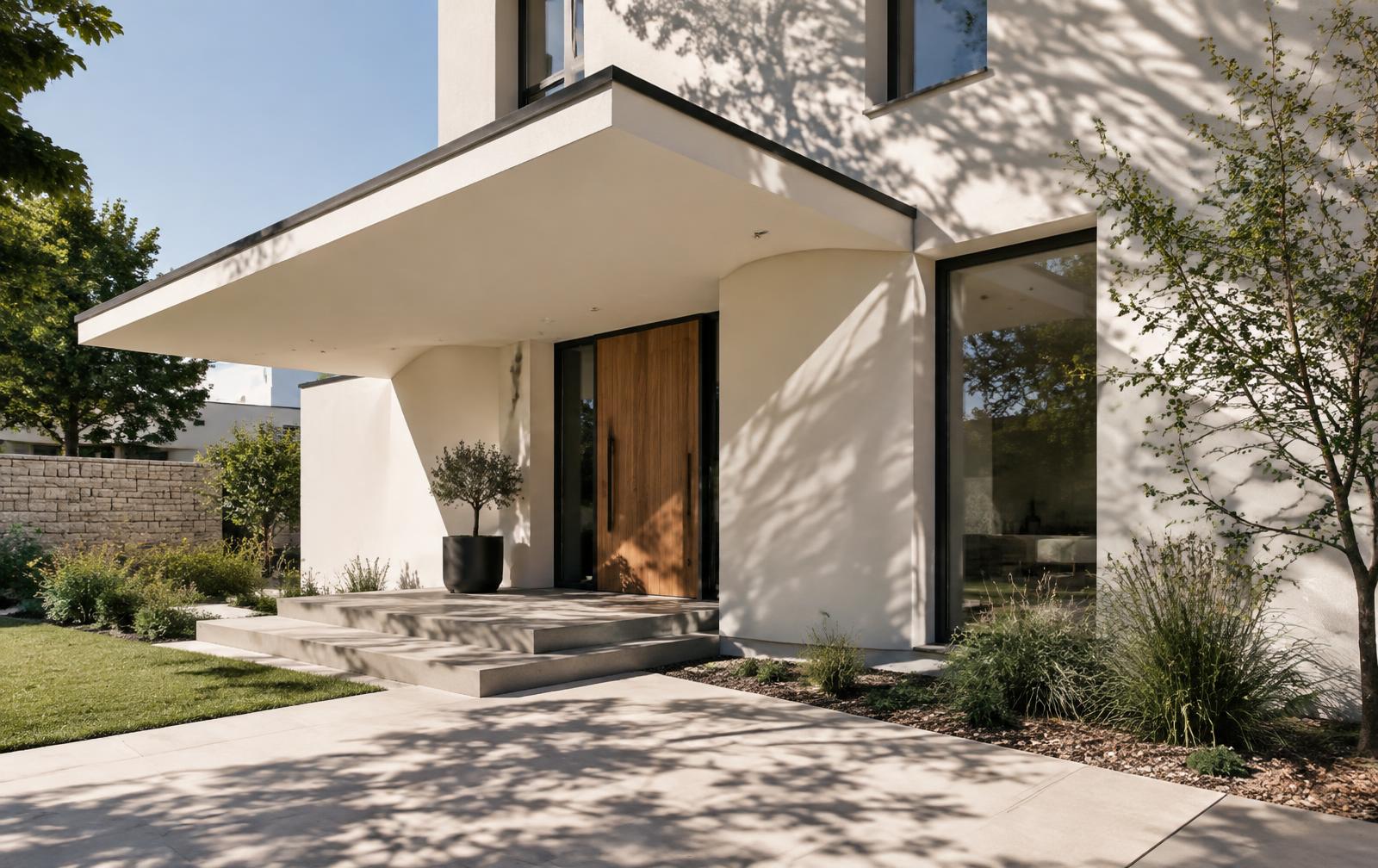 LIGHTING
Two settings carry most of the credibility in an exterior render, and neither is a material. Sun altitude decides the mood and the legibility of the massing. Shadow softness decides whether the image feels photographed or assembled. Everything else is refinement on top of those.
Start with altitude. A sun sitting high near noon flattens facades, shortens shadows, and removes the modelling that makes depth readable. It is the default in most software and the reason so many student renders look inert. Between roughly 15 and 30 degrees you get long raking shadows that describe form, warmth in the light colour, and a sky that grades rather than sitting as one blue field.
Azimuth matters as much as altitude and is easier to get wrong. Aim for light arriving across the facade rather than straight at it or straight behind the camera. Frontal light erases relief. Light arriving at 30 to 60 degrees from the camera axis picks out reveals, window heads, and material transitions, which is precisely what an architect wants the image to communicate.
Shadow softness is a function of the apparent size of the light source. The sun subtends about half a degree in the sky, so direct sunlight produces shadows that are sharp at the point of contact and progressively softer as the casting object moves away from the receiving surface. That gradient is the tell. If your shadows are uniformly soft, the sun size is inflated. If they are uniformly razor sharp, the source is a point light rather than a physical sun.
Most engines expose a size or angle parameter for the sun. Leaving it at the physical default is correct for a clear day. Increasing it slightly, perhaps to twice the default, simulates light haze and can help a scene that reads too harsh. Pushing it far higher produces overcast behaviour without the sky to match, which reads as a technical error rather than a weather condition.
Contact shadow behaviour is where I see the most failures. Where a step meets the ground, where a planter meets paving, where a door frame meets a wall, there should be a tight darkening. When that darkening is missing, objects look like they are hovering, no matter how good the shaders are. If your engine is losing those contacts, check that the geometry is actually touching and that no unintended light leak or excessive ambient term is filling in.
Sky model selection changes shadow colour more than people expect. Shadows outdoors are not grey. They are lit by the sky dome and therefore lean blue, and the degree of that blue depends on turbidity and time of day. A sky at turbidity 2 to 3 gives clean colour separation. Push turbidity up toward 6 and everything washes out into haze, which is occasionally what you want for atmosphere but rarely for a hero shot.
Dappled shadow from trees is one of the cheapest ways to make an exterior believable, and one of the most abused. The pattern must be soft enough at ground level to match the distance from canopy to paving. A crisp leaf by leaf pattern on a path five meters below a tree is physically impossible, and the eye knows it even if the viewer cannot articulate why.
A useful check is to find a photograph taken in similar conditions and compare shadow density. CG shadows are frequently too dark because the sky contribution is under weighted or the ground albedo is too low. Real shadowed asphalt is not black. Raise the sky intensity or the ground bounce until shadow interiors carry visible detail.
Finally, decide the sun position before you build camera framing, not after. Shadow direction is composition. A long shadow can lead the eye into the entrance or cut awkwardly across the facade, and discovering that after materials are finalised means redoing work that a two minute test render would have caught at the start.