Lighting · Blender, Corona
Winter scene renders: snow, ice, and the traps I fell into
Snow is not white. Ice is not clear. Breath is not steam. Here's what I learned from a season of shooting winter references and applying it to renders.
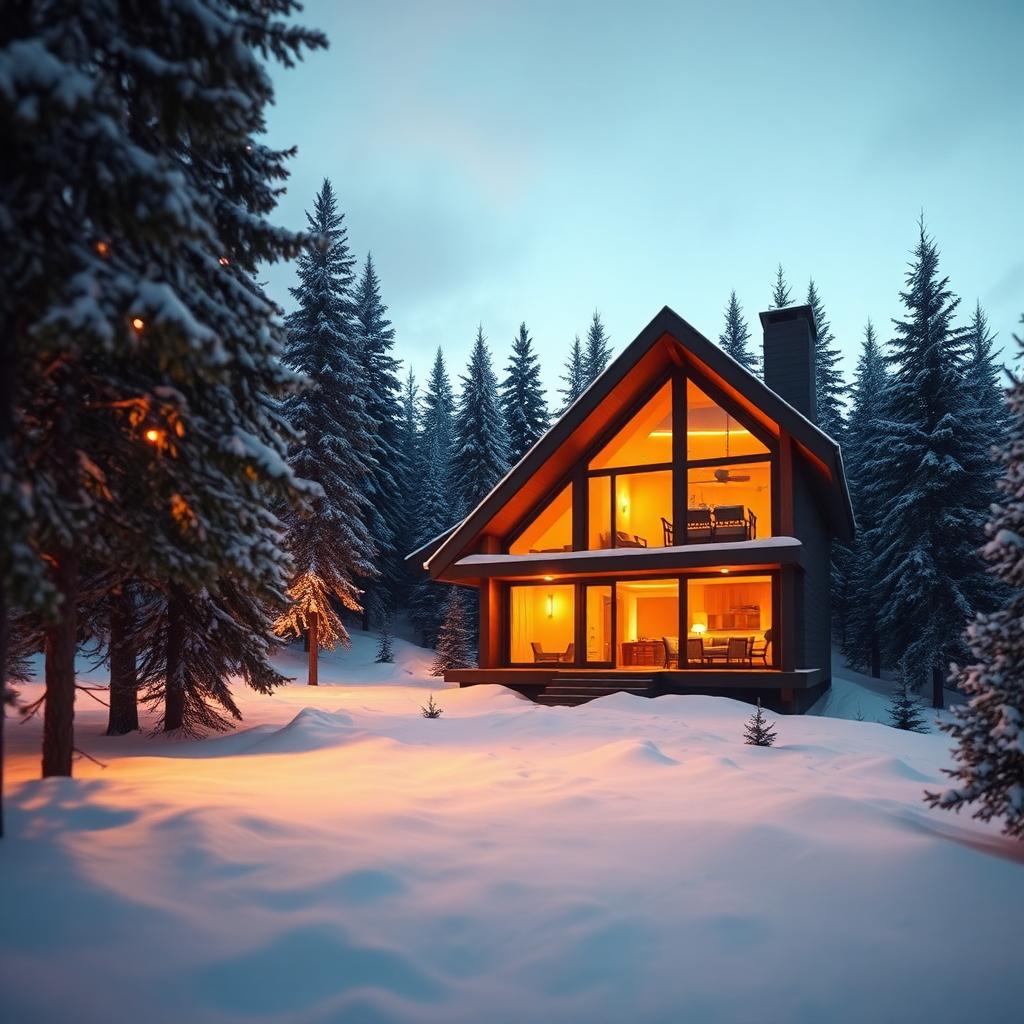 LIGHTING
I got asked to do a batch of winter renders for a mountain cabin developer last year and I thought it would be straightforward. It absolutely was not. My first pass looked like a cabin sitting in a bowl of icing sugar and the client said as much on the review call. I spent the next few weeks studying actual winter photography and rebuilding my snow shader from scratch. Here is what I learned.
Snow is not white. This is the biggest single mistake people make. Fresh snow reflects about 85 percent of visible light, but the missing 15 percent is not distributed evenly. There is a slight blue in the shadow side because subsurface scattering carries some sky blue into the snow, and there is a slight yellow warmth in the sunlit side because snow scatters warm light a bit more than cold. My snow shader is a principled BSDF with subsurface set to 3mm, subsurface color at a very slight blue tint 0.9 0.92 0.95, base color at 0.95 white, roughness 0.4. Rendered next to a pure white it reads as clearly warmer and more three dimensional.
The bigger insight was that snow accumulates unevenly. It piles up thicker on horizontal surfaces than on sloped ones. It piles up on the windward side of obstacles and gets scoured on the leeward side. It piles up thinner near buildings that have radiated any heat. If your snow layer is uniform depth everywhere, the image reads as fake before anything else does. I now drive snow depth with a mix of a proximity map to obstacles and a slope map, so the drifts collect against walls and the exposed faces stay thinner.
For the snow surface itself I use a displacement modifier at low frequency with amplitude around 40 to 80mm to give it drift shape, plus a normal map at high frequency for the small grain texture. Photographs of untouched snow have a surprising amount of small scale detail that catches the light. Without the high frequency detail the snow reads as smooth plastic no matter how good the shader is.
Ice is more complicated than snow because ice is transparent, absorbs light by depth, and cracks are what tell your eye what you are looking at. My ice shader is glass BSDF with IOR 1.31, absorption color slightly cyan at low strength, and I use a voronoi texture on the normal to add micro cracks that catch specular. Deep ice absorbs light at a rate that makes anything more than about 30cm deep read as visibly blue. Frozen puddles on the ground I keep at 20mm depth so they read as ice rather than as blue windows.
Winter light is what makes or breaks the image and the trap is thinking it needs to be blue. Cold light in a winter scene reads as cold, sure, but real winter photography is often surprisingly warm because the golden hour lasts longer in winter and the low sun angle means everything is lit at a shallow raking angle for hours. My winter renders now use a warmer sun than my summer renders, around 3800K, with a cooler sky at 8500K. The contrast between warm sun on a wall and cool blue shadow on the snow is what makes winter look like winter.
Breath. If the image has people in it, they should have breath. I composite this in post using a soft brush at 15 percent opacity, small puffs from the mouth, with a slight upward drift. Takes 30 seconds and it makes the image undeniably read as cold. Without it, people in winter renders can look like they are wearing coats for no reason. Do not overdo it. One or two puffs, and only from figures that are actually breathing in that moment.
Snow on evergreen trees is where a lot of renders fall apart because scatter systems distribute the snow uniformly across every branch. Real snow on trees is heavy on the top of branches, gone from the underside, and knocked off entirely in patches where wind moved it. I use a snow scatter mask that combines an upward facing normal check with a random noise, and I let some branches be completely bare. The variation is what makes it feel like a real forest after a snowfall rather than a stage set covered in fake snow.