Lighting · Corona
Garden and landscape lighting: night exteriors that go beyond a glowing facade
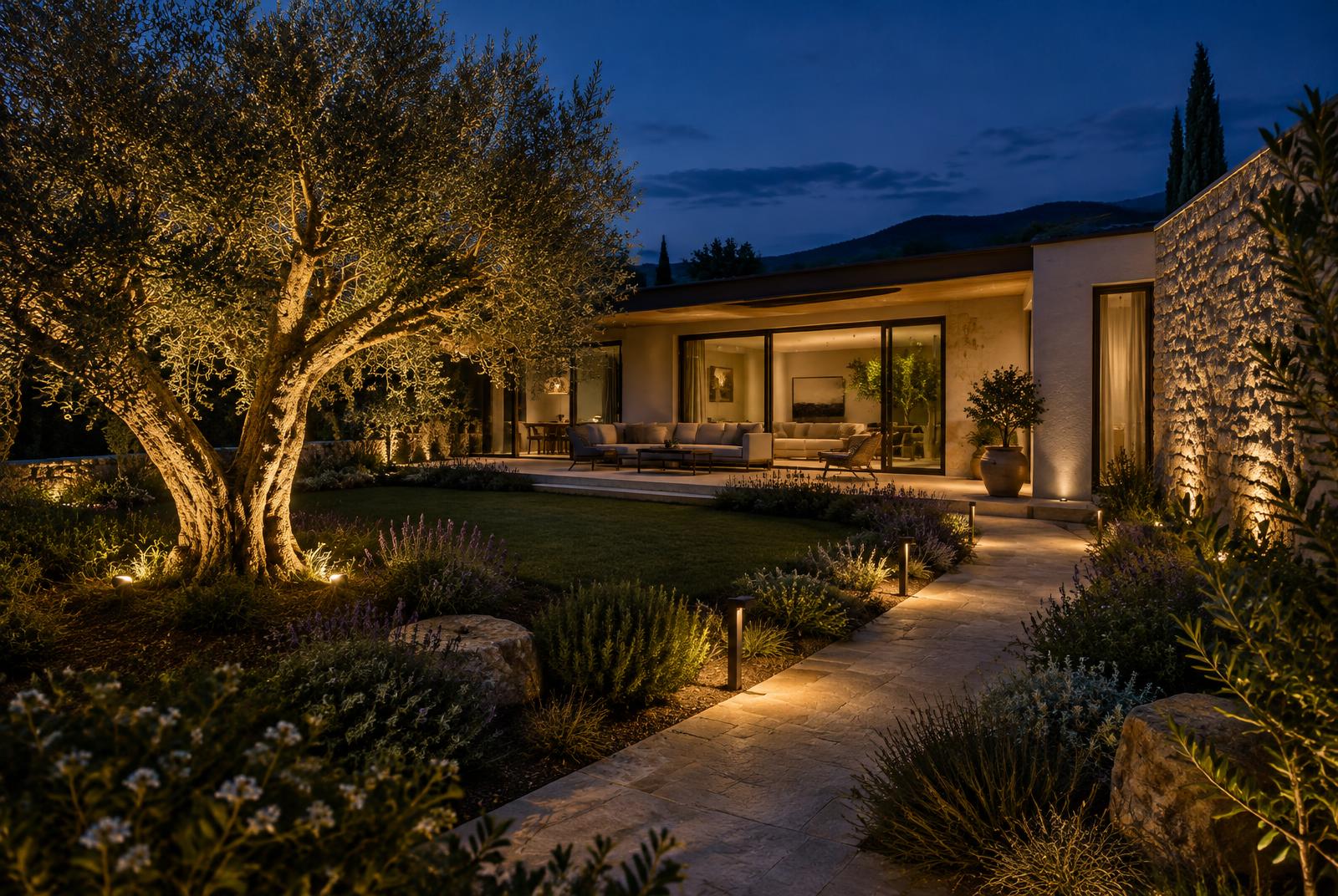
A night exterior is a landscape lighting design rendered at dusk. How to build the layers that make one believable: tree uplighting, path light pools, facade grazing, interior spill and the deep blue ambient that ties them together.
 LIGHTING
A night exterior is a lighting design, not a lit facade
Night exteriors expose a studio's lighting habits faster than any other brief. In daylight, architecture and vegetation carry the image and the sun forgives a lazy setup. After dark there is no sun to lean on, so the picture is whatever lighting design the artist invented, and a facade wash plus a scattering of random glows is instantly legible as exactly that. The renders that convince treat the garden as a designed system: fixtures with real positions, layers with real priorities, and an ambient condition that sits underneath all of it.
Start by learning how the real fixtures behave, because physical accuracy here is cheap and the payoff is large. A path light or bollard throws a small downward pool with a bright ring near the source and a fast falloff. A spike uplight placed close to a trunk grazes the bark and dies out through the canopy. A wall wash sits back from the surface and spreads evenly, while a grazing fixture sits close and reveals every ripple. Instance actual fixture geometry into the scene: the visible bollard, its warm lens disc and its pool of light are one object of belief, and a floating glow with no source reads as fake even to clients who cannot say why.
Build the layers in priority order
Landscape lighting has a natural priority order, and honouring it keeps the image organized instead of uniformly busy. Interior spill comes first, because windows are the largest and warmest sources in almost every night exterior. Tree and feature uplighting comes second, giving the scene its vertical accents. Path and step lighting comes third, threading the eye through the composition at ground level. Facade grazing is a supporting act, not a soloist. When everything is at the same intensity there is no hierarchy, and the eye has nowhere to rest.
Tree uplighting is the most misused layer. The failure is symmetry: two identical uplights at equal intensity aimed straight up a trunk, producing the Christmas tree effect. Real schemes vary. One stronger fixture close to the trunk for the bark texture, a second softer unit offset to lift a branch line, intensities graded between trees so the eye ranks them. Uplighting also changes character with the canopy: open trees like olives and birches let the light pass through and glow from within, dense evergreens stop it at the foliage shell. Match the tree species in your scene to the transmission behaviour, and let some trees stay unlit because darkness is part of the composition.
Path lights: rhythm of pools and gaps
Path lighting earns its keep through rhythm rather than brightness. Real schemes are spaced so the pools of light alternate with gaps of dark, and the eye reads the walkway from that rhythm. Space the fixtures too evenly and too bright, and the path becomes a landing strip that flattens the whole garden around it. Keep the pools small and warm, let the ground material between them fall properly dark, and check that each fixture bollard reads as a physical object catching a rim of light on its edge.
Facade grazing deserves restraint because it competes with the interior. Grazing light close to a textured wall reveals material beautifully, but a uniformly washed facade turns the architecture into a billboard. Pick one or two surfaces to graze, ideally where texture or shadow play gives something back, and leave the rest of the envelope to the spill coming from inside. Where a real scheme does wash a wall, note that brightness falls off fast from the fixture, and that falloff, not evenness, is what makes it believable.
Interior spill is the hero source
Interior spill is the hero source of most successful night exteriors, and it deserves to be built as carefully as the garden itself. Windows and glazed doors are large area sources, and everything about the image hangs on their colour and level. Keep interior lighting warm, around 3599K, so the glass reads as inhabited rooms rather than lit boxes, and let the interior brightness sit comfortably above the garden so the glass glows against the dusk. Furnish and light what the camera can actually see through the glass, because an empty glowing room is one of the most common tells in the genre.
Underneath all the fixtures sits the ambient condition: the sky. Night scenes live on a deep blue ambient, whether it comes from a night HDRI, a gradient dome or a physically dark sky with a low-intensity blue fill. The shadows in a night scene are soft and directionless in a way daylight ones never are, and that softness is a large part of why a night image feels calm. Resist the urge to add a bright moon as a second key; moonlight in renders is a mood decision, not a lighting requirement, and a dim, nearly shadowless blue base lets every warm fixture own the frame.
Exposure: protect the pools, let the darks fall
Exposure is where night renders are won or lost, and the discipline is the opposite of daylight work. Expose for the pools of light and the interior spill, and let the darks fall where they fall. The temptation is to lift the shadows until the whole garden reads at daylight levels, which destroys the very contrast that makes night convincing. A night exterior should hold detail in the brightest fixtures and in the mid tones of the path, while the planting between pools drops to near black with just enough information to keep shape. If you find yourself raising global exposure to rescue the shadows, add a weak fill instead and keep the key lights dominant.
Colour temperature discipline is worth more in night scenes than anywhere else, because contrast between temperatures is the whole story. Warm fixtures against a cool blue ambient is the classic pairing for good reason: the two temperature zones separate the designed light from the natural light, and the image reads as composed. The failure mode is an accidental mix, a cool path light here, a neutral uplight there, which reads as unfinished rather than designed. Commit to one warm temperature for all fixtures, keep interiors at the same family of warmth, and let only the ambient sky carry the cool end.
Materials that catch grazing light
The ground plane is doing more work than it appears to. Grazing light only reads if the surface it lands on has something to catch: a displaced or normal-mapped stone path, a lawn with direction, planting with real leaf geometry. Beyond texture, remember that ground materials bounce the warm pools back upward, warming the undersides of the planting around each fixture. A perfectly dark, perfectly matte ground plane kills that interplay, and the garden reads as if the light sits on it rather than in it.
Restraint in post separates professional night work from the rest. Glow and bloom around fixtures should be subtle enough that a viewer notices the light, not the effect. Lens flares belong to photography and almost never belong in architectural work. Watch emissive materials too: a lens disc should be bright, but if it blooms into a white blob the fixture stops being an object. The goal is an image a lighting designer would recognise as buildable, and no real garden glows.
Final checks before you call it done
Night scenes concentrate several technical failure modes at once, so run a deliberate final check. Noise lives in the dark areas and blooms in the gradients around every pool, so inspect the darkest quarter of the frame at final resolution before signing off on denoising; over-denoised shadows go plasticky exactly where the eye is looking. Check for banding in the sky gradient after compression, keep the deepest blacks from clipping by a hair so the planting keeps shape, and view the image at delivery size, where subtle pools either read as intended or vanish. The night exterior is usually the portfolio shot, so it deserves the same final-res discipline as the hero interior.