Workflow · Corona
Time-of-day studies: presenting one scene at morning, noon and dusk
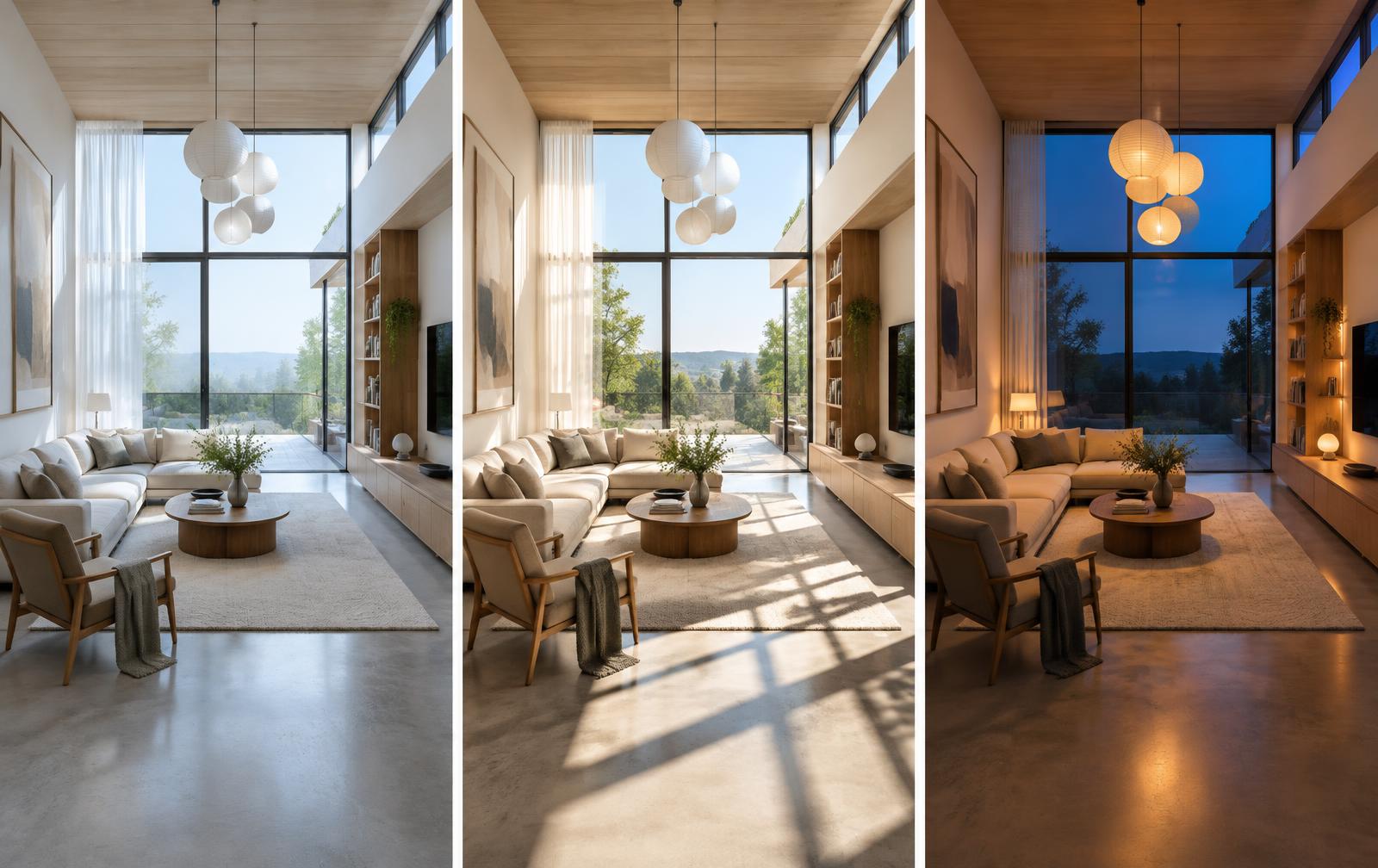
Clients rarely ask for one lighting mood; they ask to see the options. How to build a single scene that renders cleanly at three or five hours, keep the camera and grade consistent, and present the grid so the decision lands in one meeting.
 WORKFLOW
A study is one scene, several hours
A time-of-day study is the most requested deliverable that almost nobody plans for. The brief sounds reasonable: we would like to see the living room in the morning, at midday and in the evening. It reads as one extra render and arrives as three. The study is not three renders of a scene, it is one scene lit with the discipline to survive being re-lit, and the difference between those two things is visible the moment the frames sit side by side. A set where each hour has its own camera tweak, its own prop drift and its own grade stops looking like one building at three hours and starts looking like three buildings that happen to share furniture.
The definition worth holding onto: a study is the same camera, the same model, the same materials, with only the light changing. If the camera moves, you are making an image set, which is a fine product but not a study, and it will not answer the question the study exists to answer. The question is almost always about the architecture: how does this room behave through the day, where does the sun land on this facade, which window turns this corner into the best seat in the house. One fixed camera held across every hour is what makes those answers comparable, and comparability is the entire value of the deliverable.
Build for variation from the start
Scenes that survive a study are built for variation from the start, which is a modeling and layering discipline rather than a rendering one. The daylight system is the only thing that should change between hours, so the artificial layer needs to stand on its own: every practical light is a real fixture with real geometry, grouped into light-select or layer controls, and every window has an aperture that admits the sky without leaking around a frame. Scenes that were lit once and hacked brighter afterwards show their seams the moment the sun moves, because the fudge that hid one hour's imbalance is the wrong fudge for the next.
Modern renderers make the variation itself a rendering decision rather than a rebuild. Corona's LightMix and V-Ray's equivalent light-mix render elements let you save each lighting layer to its own channel, which means one render pass produces every hour: the sun layer, the sky layer, the interior practicals, the accent lights, each separable, each re-weightable in compositing afterwards. The workflow implication is significant. Three hours becomes one render time plus compositing, and the client who asks for a fourth hour after the meeting gets it in twenty minutes rather than in another farm night.
Morning: low, cool and honest
Morning light is the frame most briefs underuse, and it has a distinct job. The sun sits low and cool, shadows run long and rake across surfaces to reveal texture, and interiors that read neutral at noon pick up a clean blue-silver cast through the glazing. Morning is the hour that flatters timber grain, stone texture and any surface with relief, because grazing light is what texture lives on. It is also the honest hour: the room is at its most exposed, nothing is lit for atmosphere, and if the materials are wrong, morning is where the client will see it first. Use morning to prove the architecture, not to seduce.
Midday is the reference frame and the hardest to make interesting, because the sun is high, shadows are short and vertical surfaces are lit flat. The mistake is fighting it: pushing a fake low sun into a scene that is supposed to be noon reads as wrong to anyone who lives with the building. Instead let midday do what it does well. Overhead light puts contact shadows under every object and floods the floor plane, which is where polished floors, large-format tile and pale concrete earn their keep. Overcast or bright-diffuse variants of midday also suit briefs about calm: clinics, galleries, offices, anywhere the brief says even light rather than drama.
Midday: overhead sun and contact shadows
Golden hour and dusk are the frames clients react to, and they deserve their reputation, but they earn it through contrast rather than brightness. Late sun comes in raking and warm, pushes long shadows across the plan and puts one hot side of the room against a cool shadow side. Dusk goes further: the sky drops to deep blue, the interior lamps take over as the primary sources, and the 3599K interior standard carries the frame while the windows become the accent. These are also the frames where every shortcut in the artificial layer shows. A dusk study of a scene whose lamps are placeholder glow will look like a catalog of floating light patches, and no grade rescues that.
Consistency is what turns three renders into one study, and most of it is unglamorous bookkeeping. One camera, locked, no reframing between hours. One exposure philosophy, usually expose for the daylight side and let the practicals sit as pools. One grade recipe applied per frame with only the balance shifted, not a different look per hour. White balance can be chosen per frame, warm-leaning for dusk, cooler for morning, but it should read as one photographer making one decision per hour rather than three photographers agreeing to disagree. The eye compares frames in a grid at a glance, and any inconsistency at a glance reads as error.
Golden hour and dusk: the money frames
Presenting the grid is a skill of its own, because the deliverable is a decision support tool, not a portfolio spread. Lead with the frame the brief most needs, the dusk exterior for a marketing push, the morning interior for a workspace, and place the supporting hours around it at equal size rather than shrinking them into thumbnails, because a grid the client cannot compare is a grid that generates another revision round. Name the hours on the frames, not just in the file names. And present the hero image large somewhere in the deck, because the study exists to inform a choice about the hero, not to replace it.
Cost control is what makes studies profitable, and it comes from channels rather than from render time. The light-mix workflow already collapses three renders into one pass, and the same discipline extends to the rest of the image: denoise at a matched quality setting across every frame in the set, because mismatched denoiser strength between hours is visible in the grid instantly. If the scene includes a moveable sun, render the sun layer once per hour and reuse everything else. The frames that hurt are the ones re-rendered wholesale for a change that only touched one light, and those are entirely a planning failure.
One camera, one grade, one decision
The most common failure in time-of-day sets is the brightness-only study, where the artist re-rendered the same scene three times with the sun intensity and colour tweaked and nothing else. The frames read as a dimmer switch, not as three hours. Real hours change sun direction, which changes which surfaces receive light at all; they change sky colour and angle, which changes what the windows carry into the room; and they change the role of the practicals, from invisible fill at noon to the primary source at dusk. If your three frames could be brought to the same image with exposure and white balance sliders, the study is not done.
How many hours is a scoping decision, and it is worth making explicitly. Three, usually morning, midday and dusk, answers most residential and small commercial briefs. Five, adding a second morning angle or a night frame, suits projects where the hours are part of the program: restaurants, hotels, offices with long trading or working days. Beyond five the grid stops being readable and becomes a portfolio, which is a different product at a different price. Scope the count into the fee rather than discovering it in revision, because a client who has seen three hours will always ask about the fourth.
Presenting the grid
Close on why the study earns its cost: it moves the conversation from taste to time. A client arguing about a lighting mood is often arguing about something they cannot name, and the grid gives them a vocabulary, this hour, not that one. It also protects the artist, because the delivered frames record that the alternatives were shown and a choice was made. A scene built to be studied, one camera, layered lights, channels saved, is also simply a better production scene for everything that follows, which is the quiet reason the discipline is worth imposing even when the brief did not ask for it.