Lighting · V-Ray
Mixed lighting: balancing daylight and artificial light in interior renders
Most bad interior renders are not badly lit, they are lit twice: a daylight setup and an artificial setup that never agreed on a time of day. How to choose the hour, separate colour temperatures, balance the two sources and keep the mix from going muddy.
 LIGHTING
Two sources, one exposure
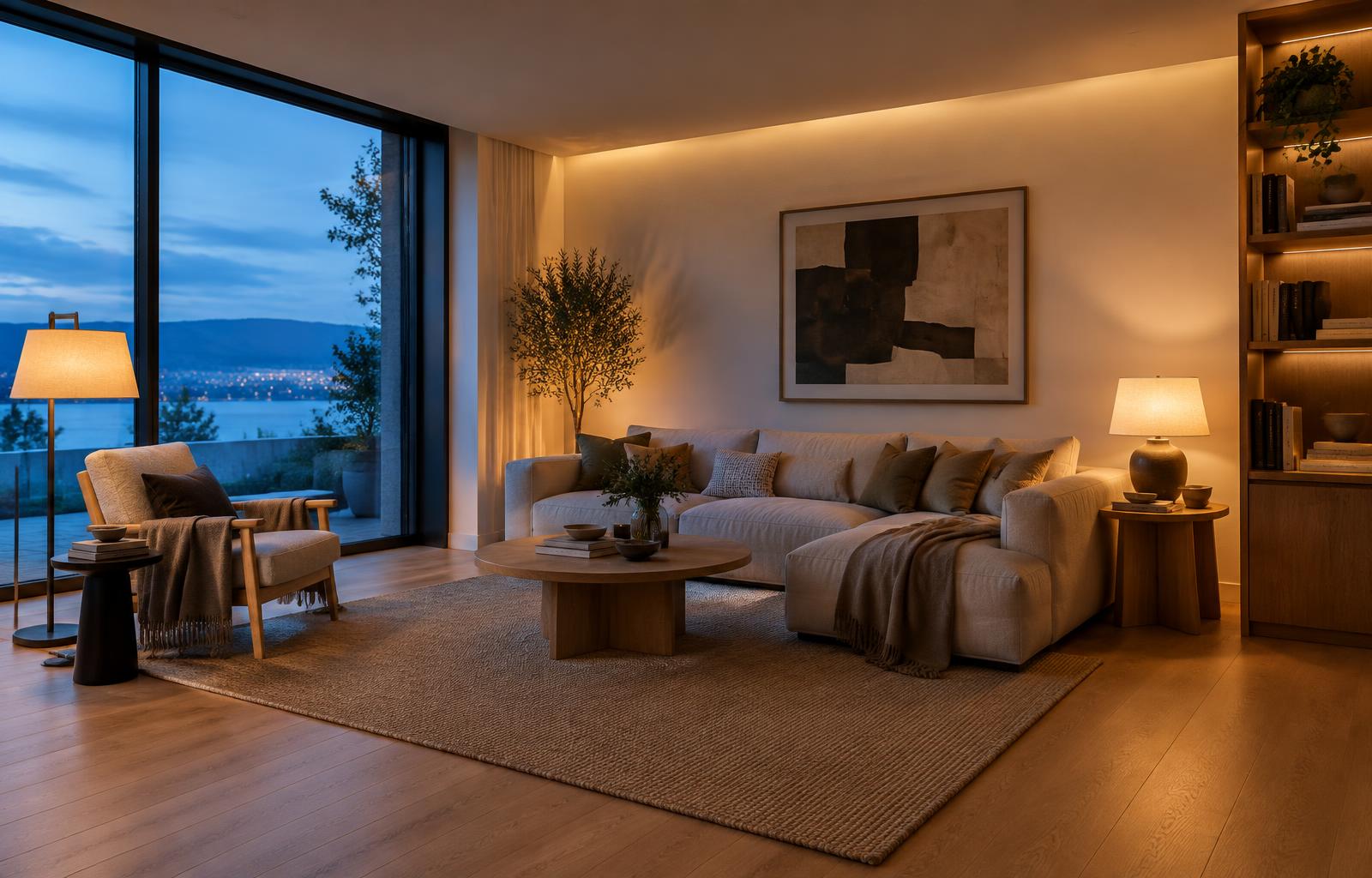
Plenty of interior renders are not badly lit; they are lit twice. A physically plausible daylight setup sits underneath a plausible artificial setup, but the two were never asked to agree on a time of day, a colour temperature or a hierarchy. The result is the muddy in-between: a room where nothing is dark, nothing is bright, the windows read as pale grey wash and the lamps as faint orange smudges. Real interiors at the hours clients love, early morning, late afternoon, dusk, are always mixed-light scenes, so the skill is not choosing one source but directing two.
Mixed light is the default condition of real rooms. Daylight alone exists at noon with the curtains open and the lights off, a scene that photographs well and feels like a showroom. Artificial light alone exists deep at night, a scene that reads moody but hides the architecture. Everything between those poles, which is where people actually live, has both sources active and negotiating. Retail, hospitality and office renders live in this condition permanently, because those spaces trade for long hours against windows that never stop letting the outside in. Learning to direct the mix is therefore not an advanced trick; it is the base skill of interior lighting.
Decide the time of day first
Everything starts with the hour, because the hour sets the ratio between the sources and no other decision matters until it is made. Late morning daylight drowns the lamps and they become set dressing; early dusk gives the lamps real work to do and the sky its best colour; full night hands the whole image to the fixtures. Decide the hour deliberately, write it down, and light to it: the sun angle, the sky brightness and the intensity of every fixture should all be consistent with one specific time. The muddy render is almost always a noon sky with a 7pm lamp balance, each half of the scene lit for a different moment.
The hour also dictates what the artificial lights are for. In a bright daytime scene, the fixtures exist to fill corners the sun cannot reach and to flatter the materials the camera cares about; their contribution should be felt more than seen. At dusk they become co-leads: the pools of lamp light define the seating area, the cove defines the ceiling, and the daylight shrinks to a rim along the glazing. If your scene has a story, someone arriving home, a dinner being set, the hour is part of that story, and the light ratio is how the image tells it. Render the same camera at three hours early in a project and pick the one that carries the brief, rather than discovering the choice after delivery.
Colour temperature separation
Colour temperature is where the mix earns its keep or collapses, and the discipline is separation. Warm lamps at 2700 to 3000K against cool daylight or a blue dusk sky is the classic pairing because the two temperature zones read instantly as designed contrast: the warm zone says inhabited, the cool zone says outside. Keep interior fixtures in the same warm family as the 3599K interior standard and let only the daylight carry the cool end. The failure mode is the accidental in-between, a neutral 4000K here, a slightly warm lamp there, which reads as unfinished rather than deliberate and flattens the very contrast the scene was lit for.
White balance is a decision about who the image is loyal to, and there is no neutral option. Balance the camera to the interior and the daylight through the glass goes blue, which flatters warm interiors and makes the window a colour event. Balance to the daylight and the interior goes amber, which suits dusk scenes that want to feel like evening. What does not work is splitting the difference at around 4500K, which mutes both ends and gives the mush its final polish. Choose the loyalty the brief wants, commit, and check the white walls in both zones: they are where the two sources meet and where any half-decision will be visible first.
Practical lights need visible fixtures
Practical lights need to be physical objects with believable output, not floating glows. Model the fixture, put a visible emissive disc or filament where the lamp sits, and let the shade or the diffuser glow exactly as its material would. The reader's eye checks fixture logic unconsciously: a downlight must make a downlight pool, a shaded table lamp must throw its light down and sideways with the shade's rim glowing, a cove must come from somewhere the ceiling can hide. A scene where the lamp glow has no lamp reads as fake to clients who could never articulate why, and no amount of post-production rescues it.
The fixtures also structure the lighting hierarchy for you. Each practical is a small, local story: the reading chair lit by its floor lamp, the kitchen counter washed by its pendants, the artwork lifted by its picture light. Those stories are what make a mixed-light interior feel inhabited rather than staged, and they are cheap to build once the fixtures exist as geometry. Keep their intensities graded, one or two anchors and the rest supporting, because ten equal pools read as a supermarket ceiling. The daylight sets the base, the practicals write on top of it, and neither should erase the other.
Exposure and the light mix
Exposure in a mixed scene is a balancing act with a rule of thumb: expose for the daylight side and let the lamps read as pools rather than floods. In practice the window side of the scene usually sits three to four stops above the ambient lamp contribution in a convincing dusk interior; less than that and the windows stop glowing against the room, more and the interior dies into a black cave with jewellery boxes of light. Modern renderers make this a mix control rather than a rebuild: render the daylight and artificial layers into separate channels, then rebalance the ratio in compositing instead of re-rendering at three intensities. That single workflow change is the difference between fine-tuning a dusk scene in an afternoon and rendering it a dozen times.
The grade then decides how the two temperatures sit together in the final image, and restraint is the whole game. A gentle global grade that protects the warm lamps and the cool windows does the job; heavy teal-and-orange styling is a look the eye tires of fast and dates faster. Watch the mid tones, because that is where mixed scenes go muddy: if the walls between the window light and the lamp pools sit in a lifeless grey-brown, either the ratio is wrong or the white balance split the difference. The test is whether the room still has a bright side and a warm side after the grade, because a mixed-light image that resolves into one even tone has stopped being mixed lighting and started being flat lighting.
Material response under mixed light
Materials respond differently to the two sources, and that response is a quiet quality signal. Glossy floors and stone surfaces pick up both: cool daylight slides along them at grazing angles while warm pools sit under the lamps, and that double signature reads as richly layered rather than conflicted. White walls are the honest witnesses, showing the colour of whatever dominates their part of the room, which is why they are the first place a temperature mistake shows. Fabric and skin live mostly in the warm pools, so check they keep their warmth even where the cool fill touches them; a face or a linen sofa gone grey-violet is the mix poisoning the subject.
Noise also behaves differently in mixed scenes and deserves its own check. The lamp-lit areas are low-energy and sample slowly, so they are where residual noise and splotchy indirect light collect, exactly where the eye looks at dusk. Give the practical lights enough samples or subdivs to come out clean, and check the darkest quarter of the frame at final resolution before accepting the denoiser's work, because over-denoised shadows flatten the lamp pools into plastic. Fireflies concentrate where bright fixtures meet glass and mirrors, the same failings covered in any glass-heavy interior, and mixed scenes stack those conditions.
Checks before sign-off
Finish with a short checklist, because mixed-light failures are predictable and therefore cheap to catch. One hour of day, stated and consistent across sun, sky and fixtures. One temperature split, warm interior against cool exterior, with no neutral in-between. White balance chosen for a side, not split. Every glow has a visible fixture and a plausible pool. Ratio preserved: windows bright, lamps as pools, mid tones alive. Noise inspected in the lamp-lit dark. A mixed-light interior that passes those six checks will look intentional in any crop a client takes, which is the standard dusk renders are now judged against.